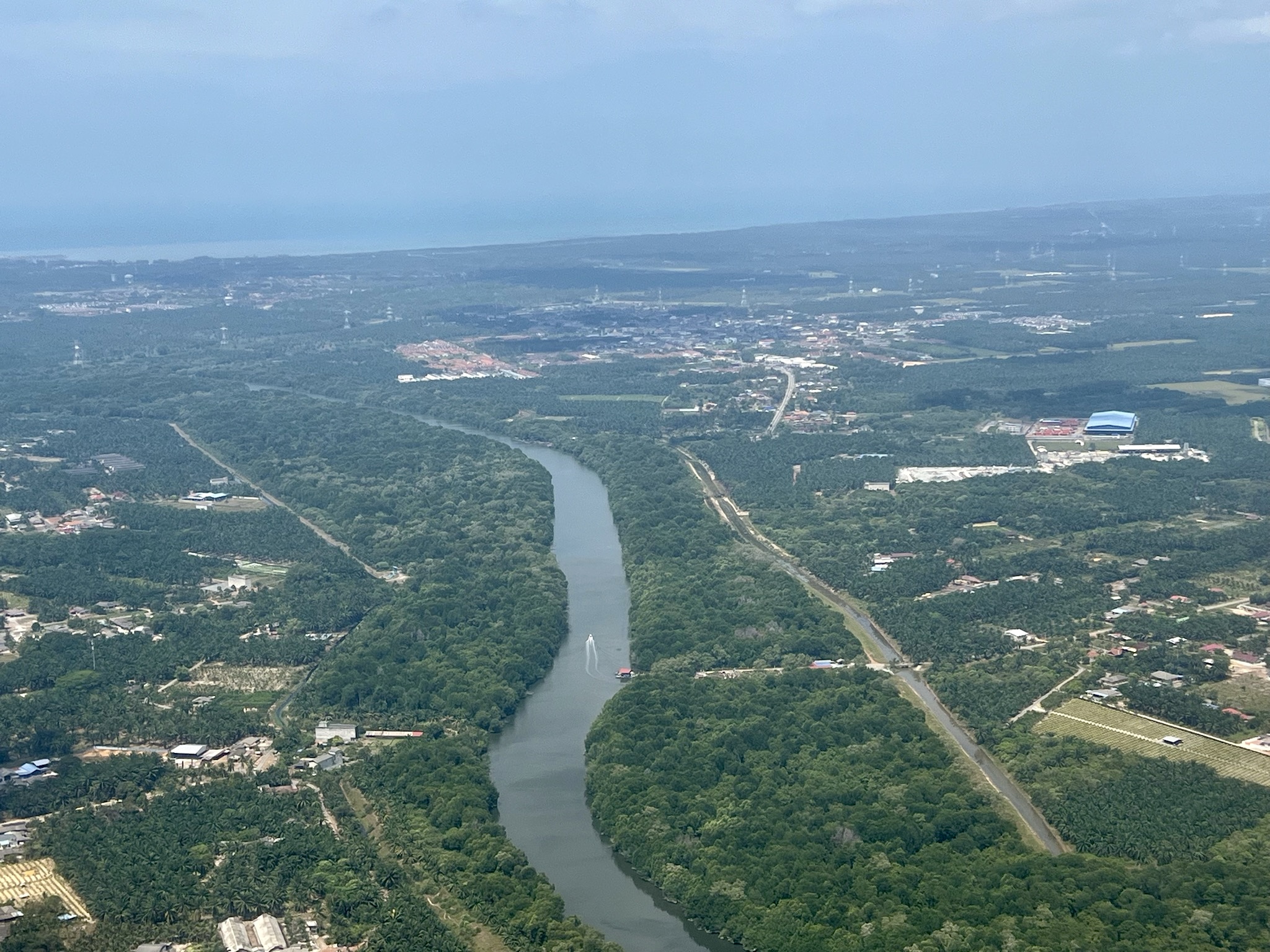
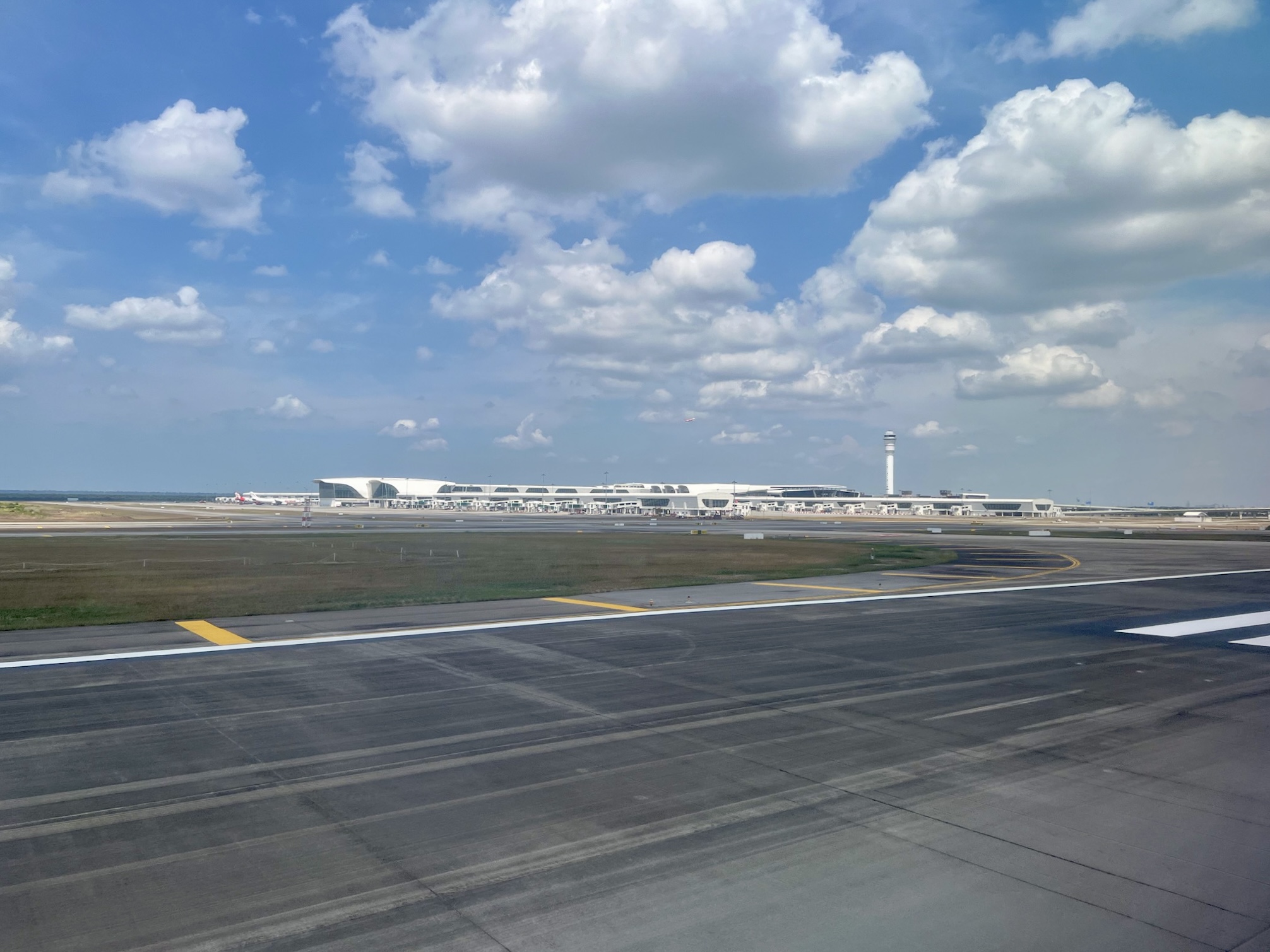
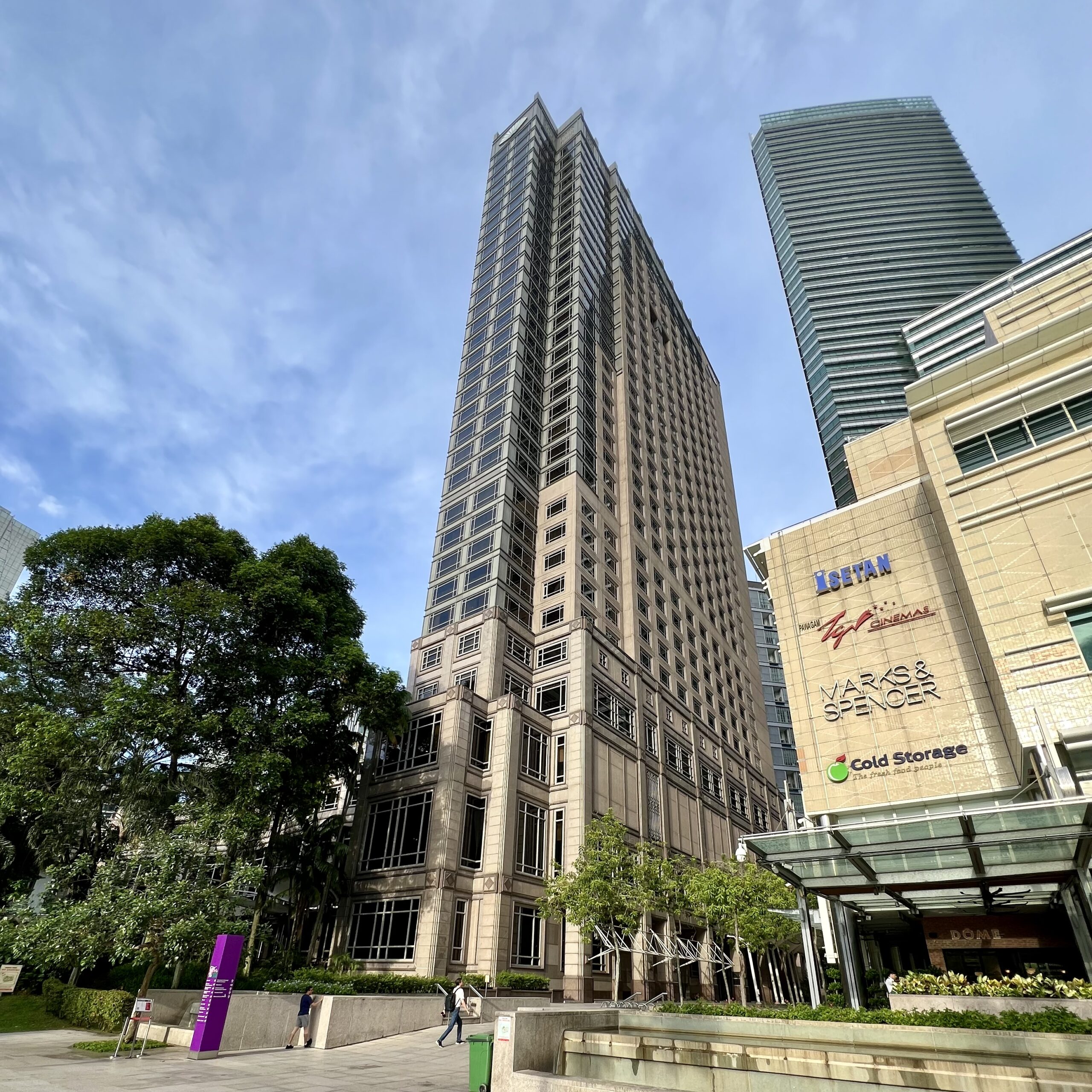
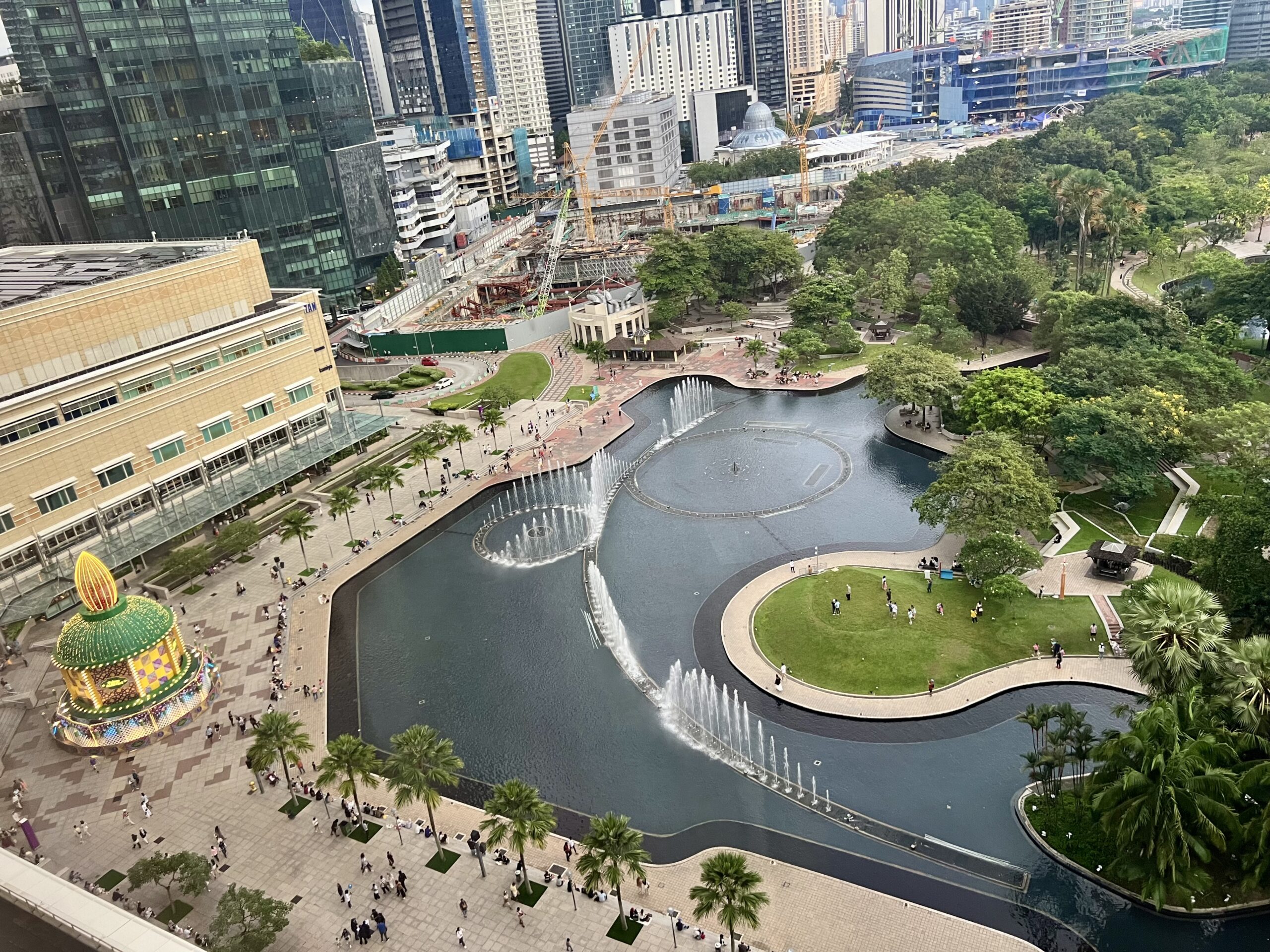
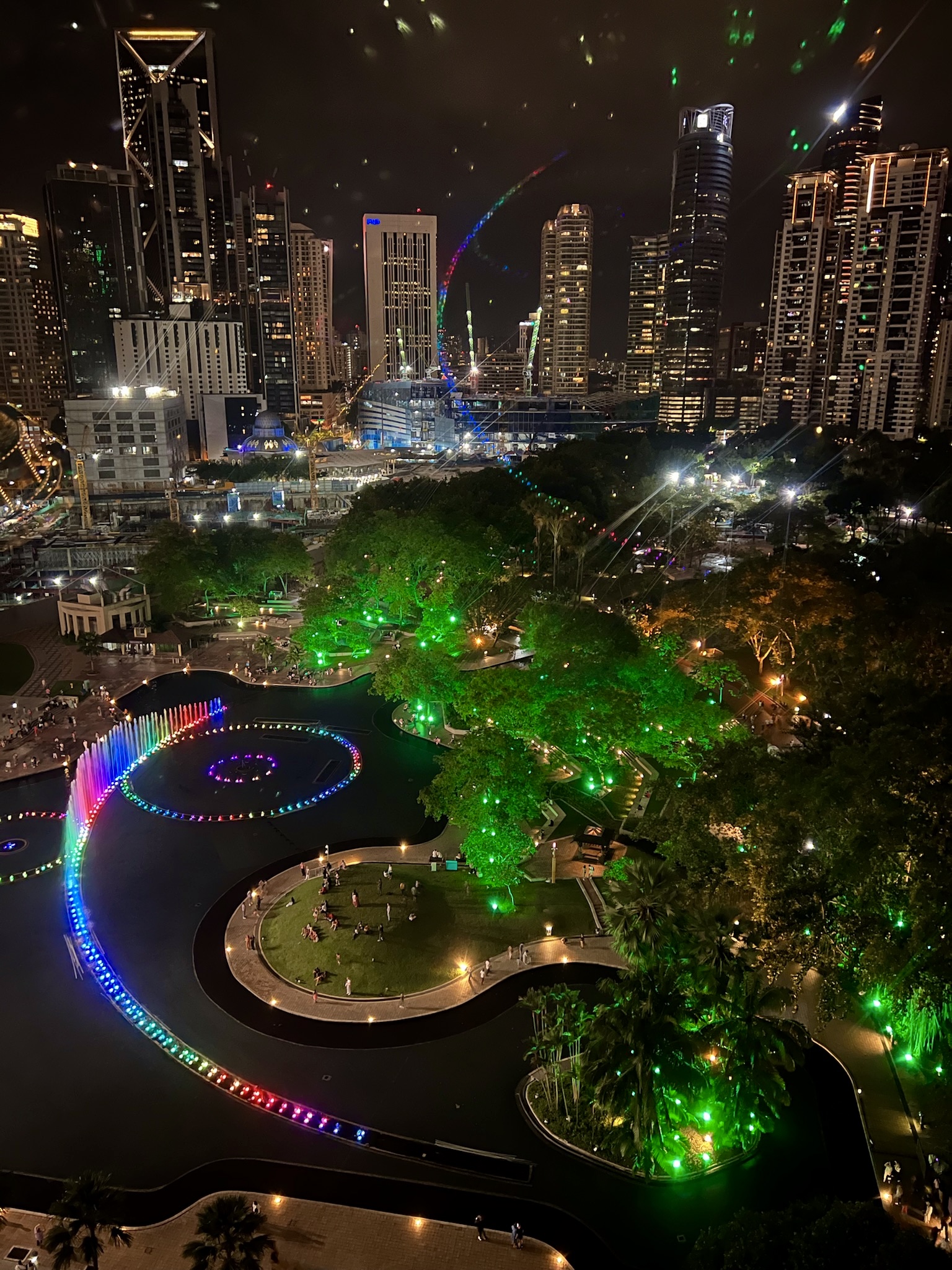
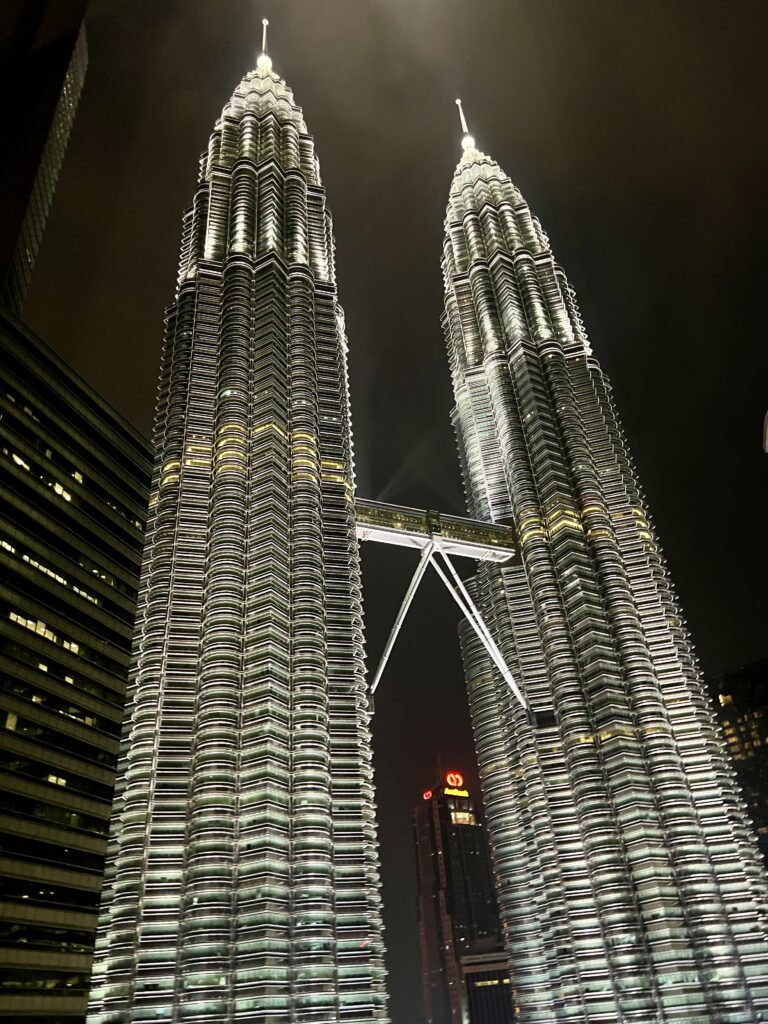
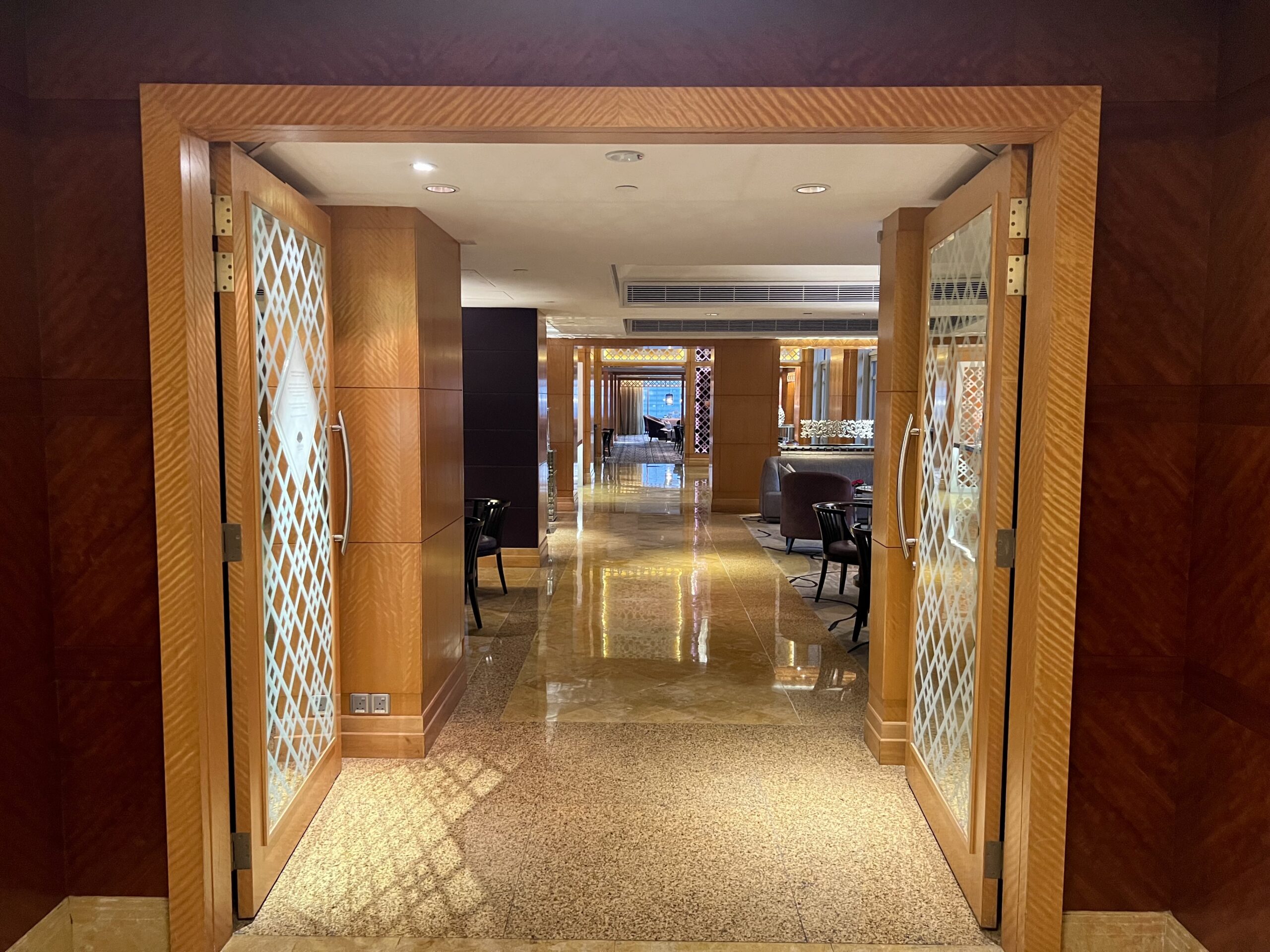
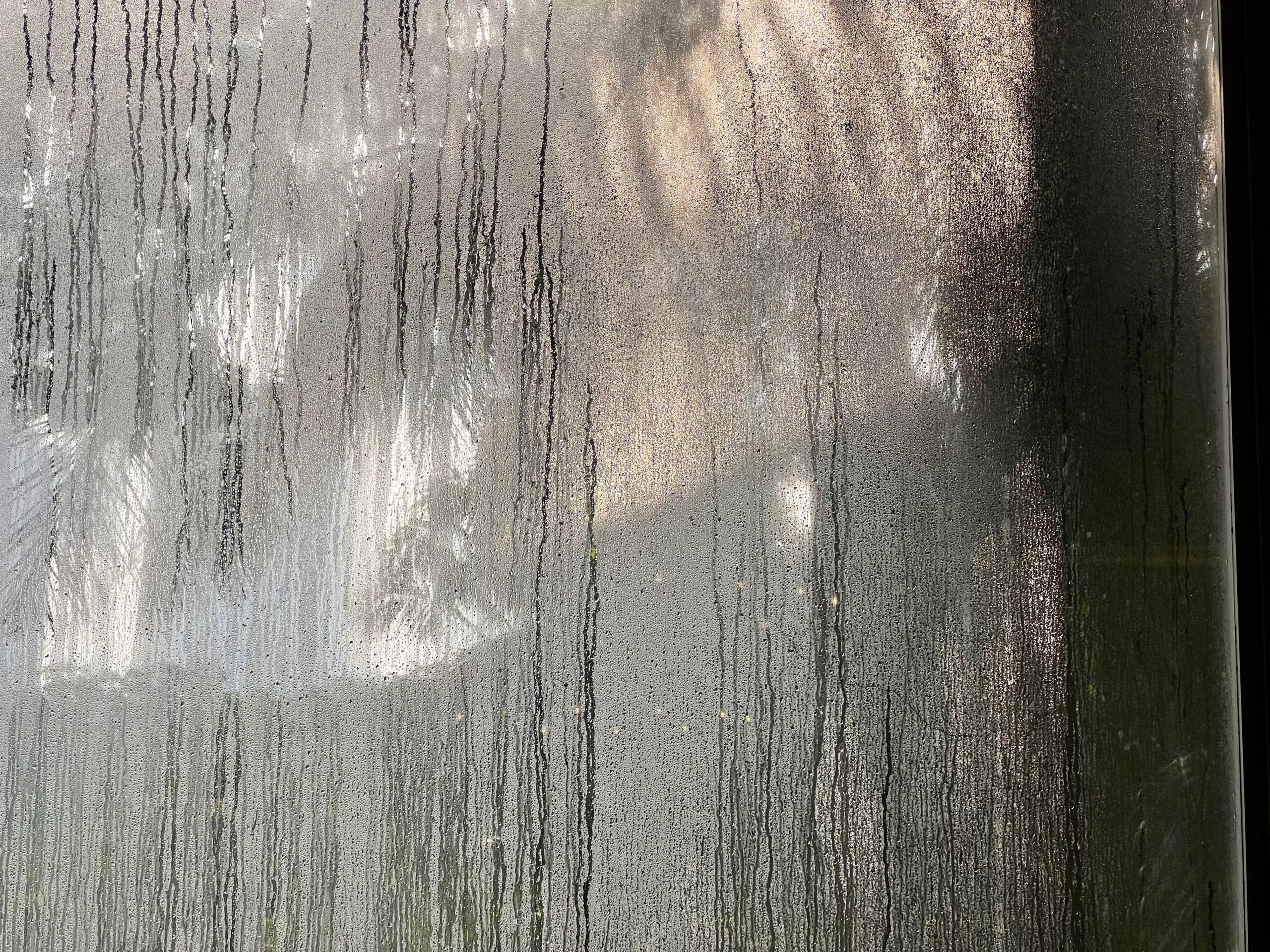
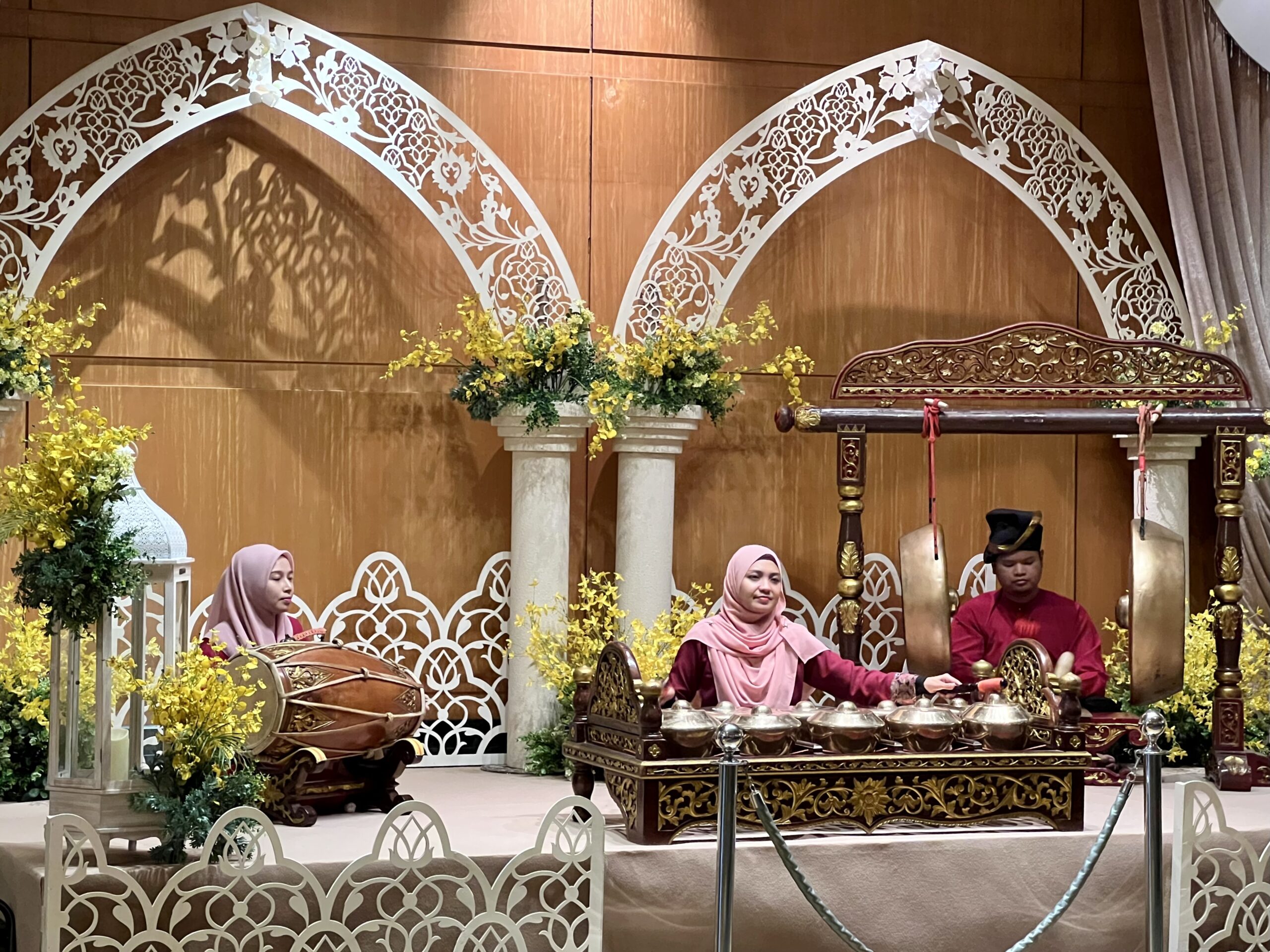
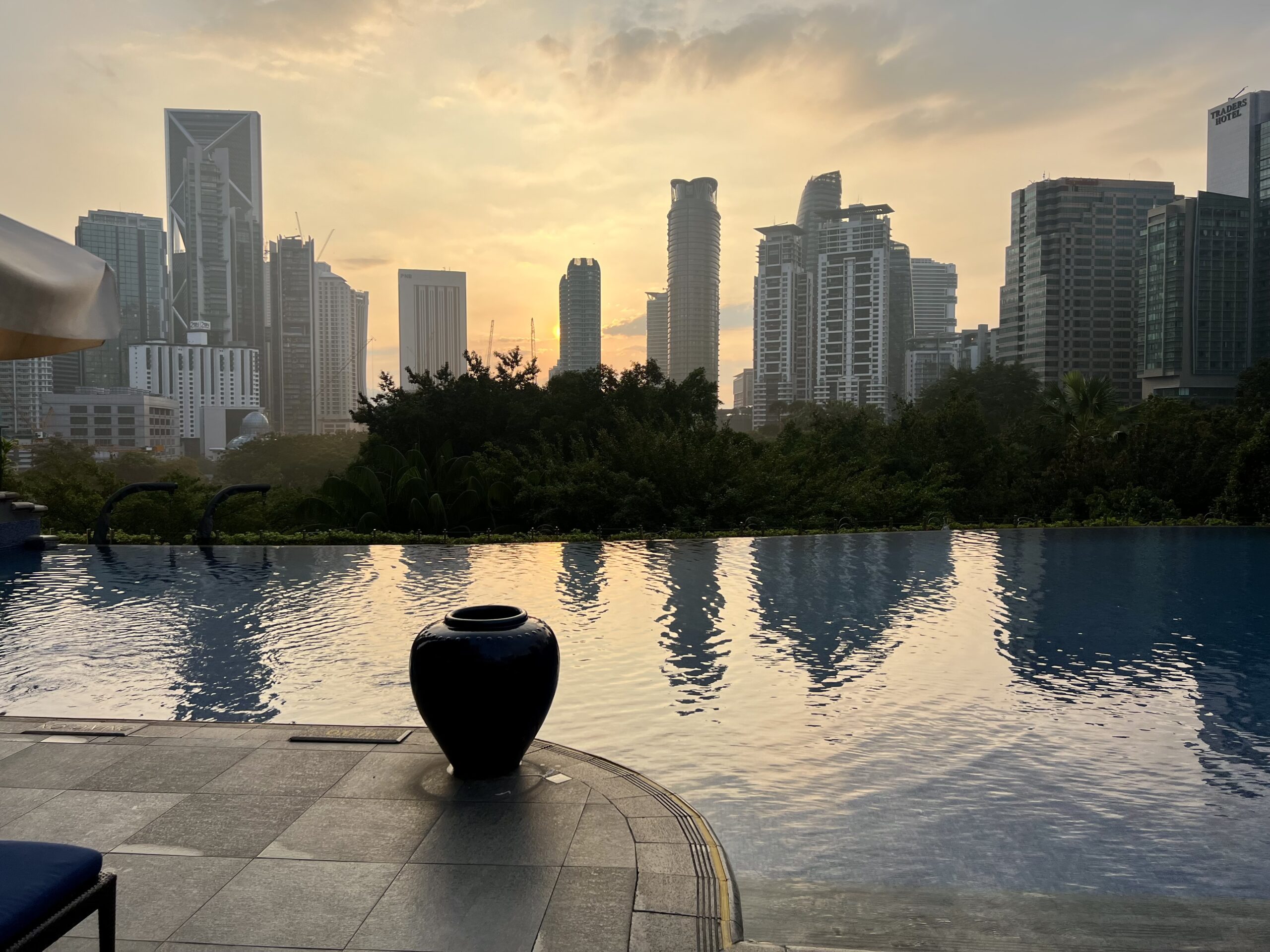
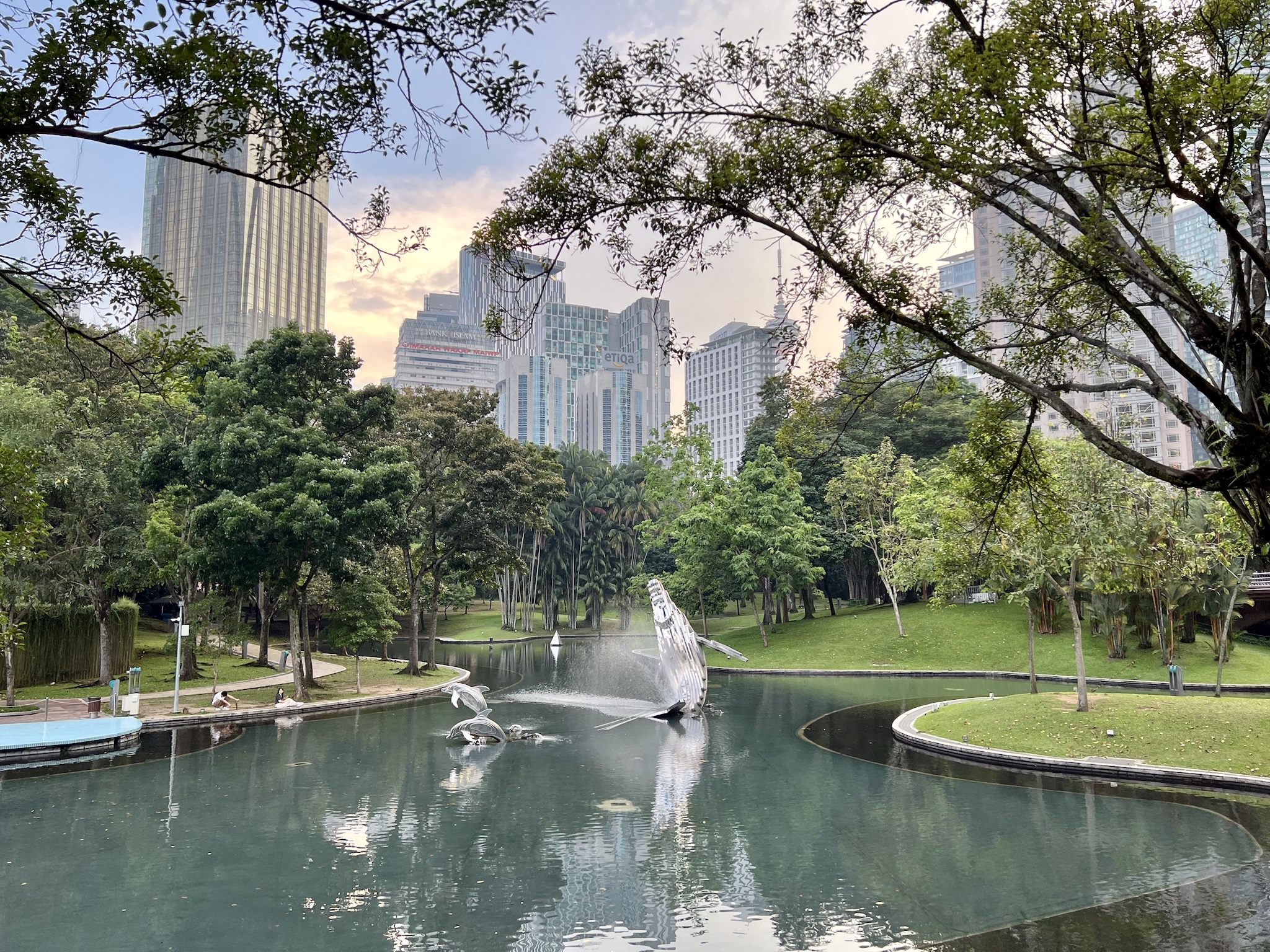
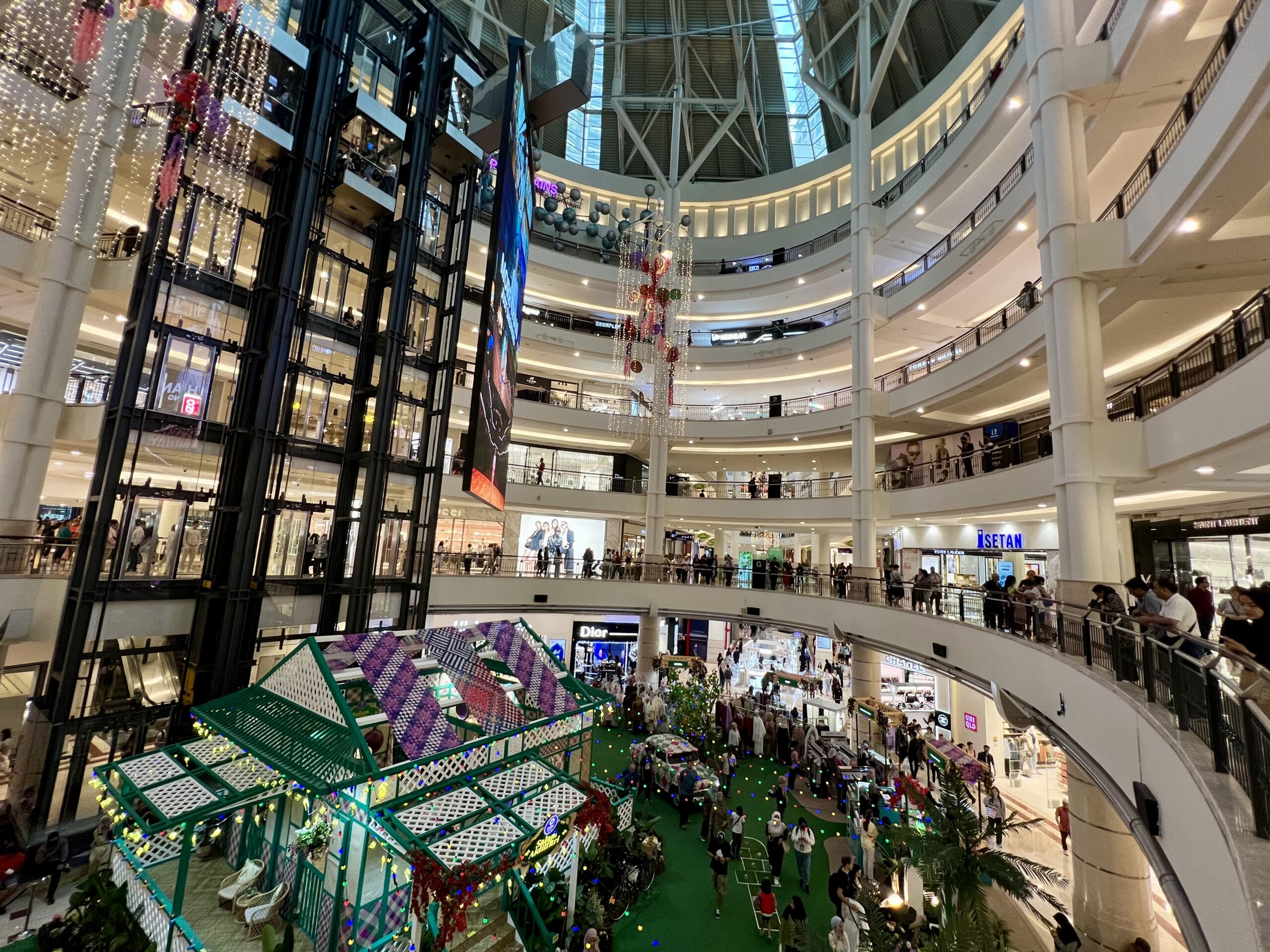
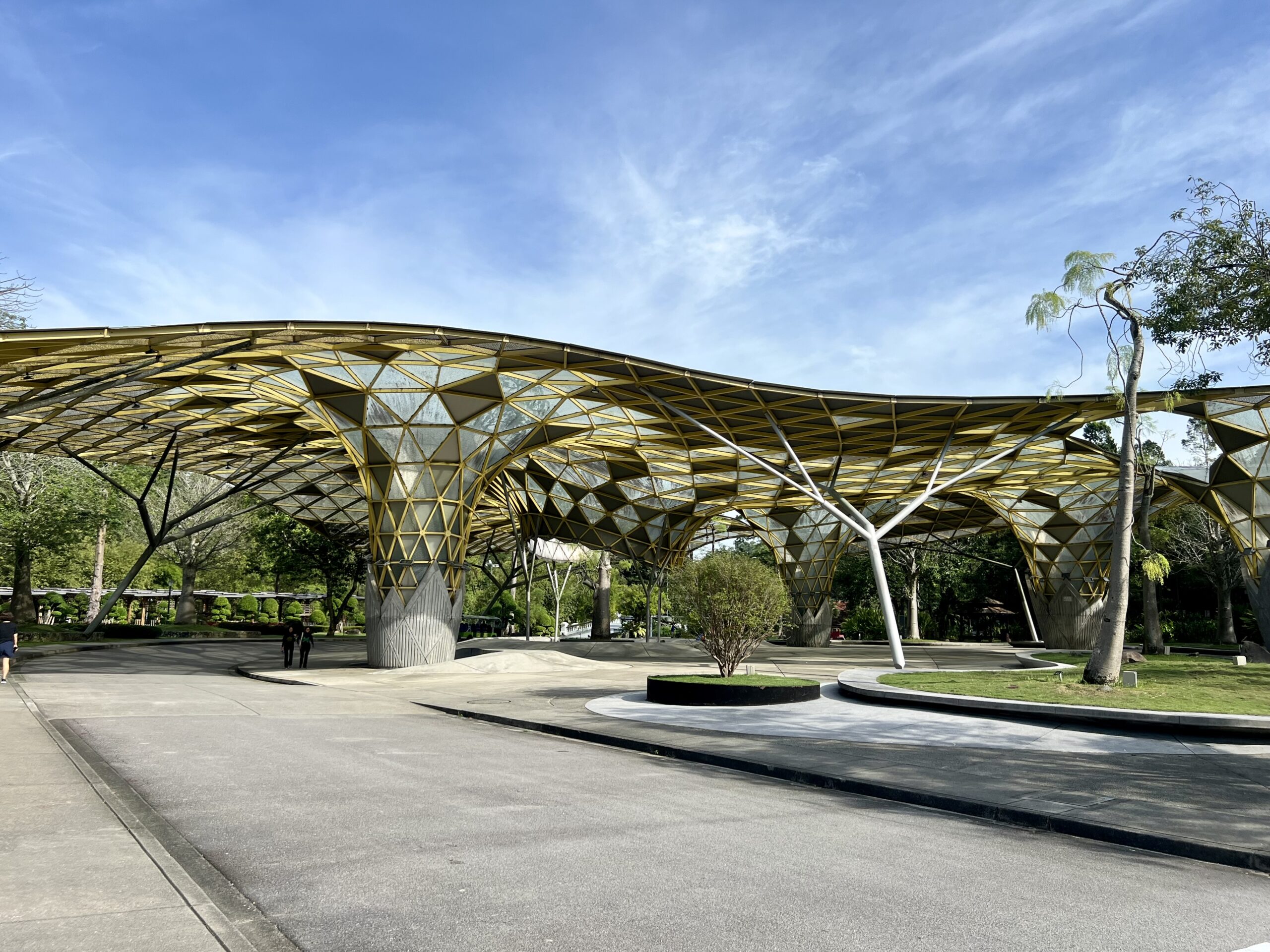
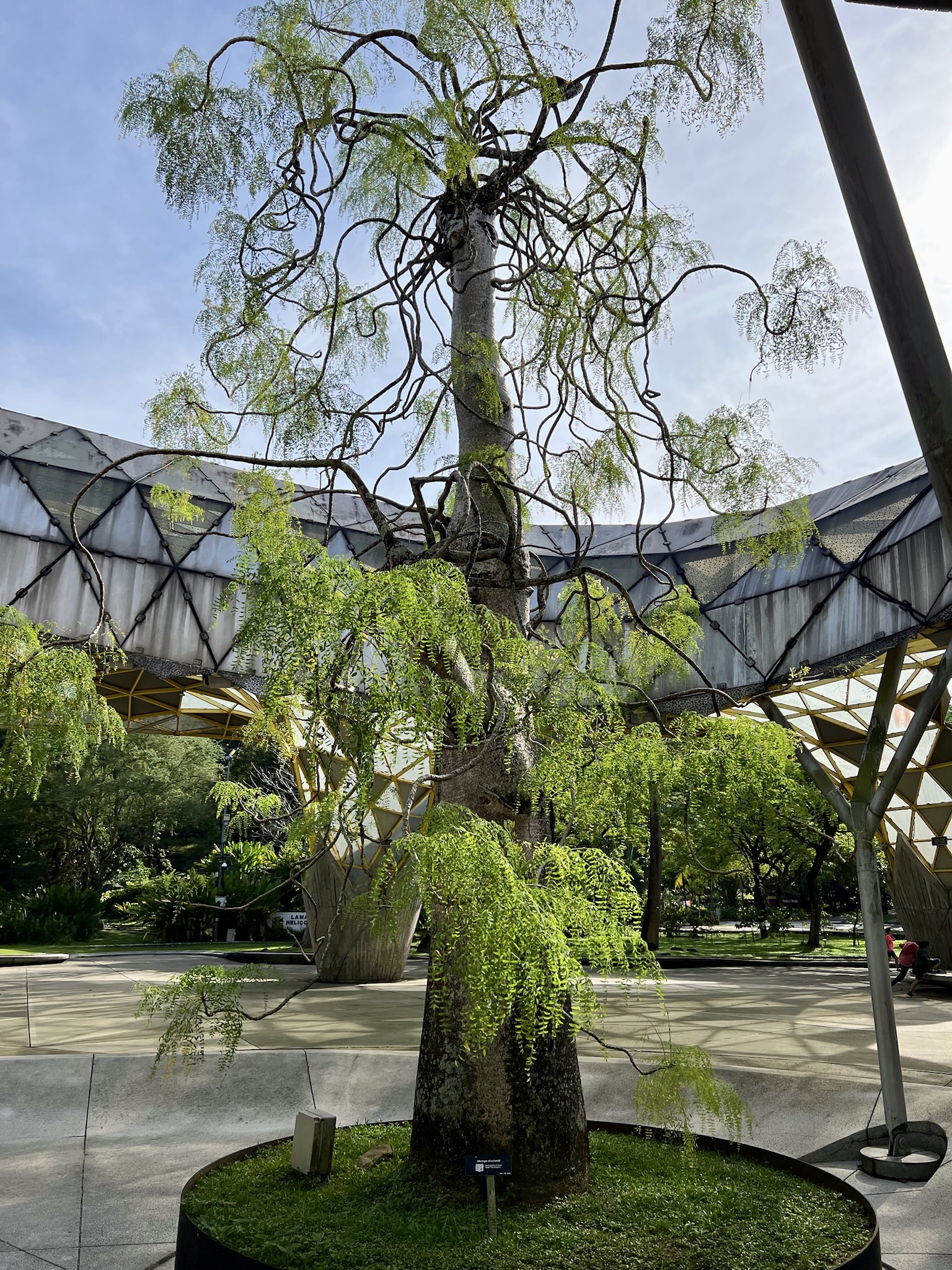
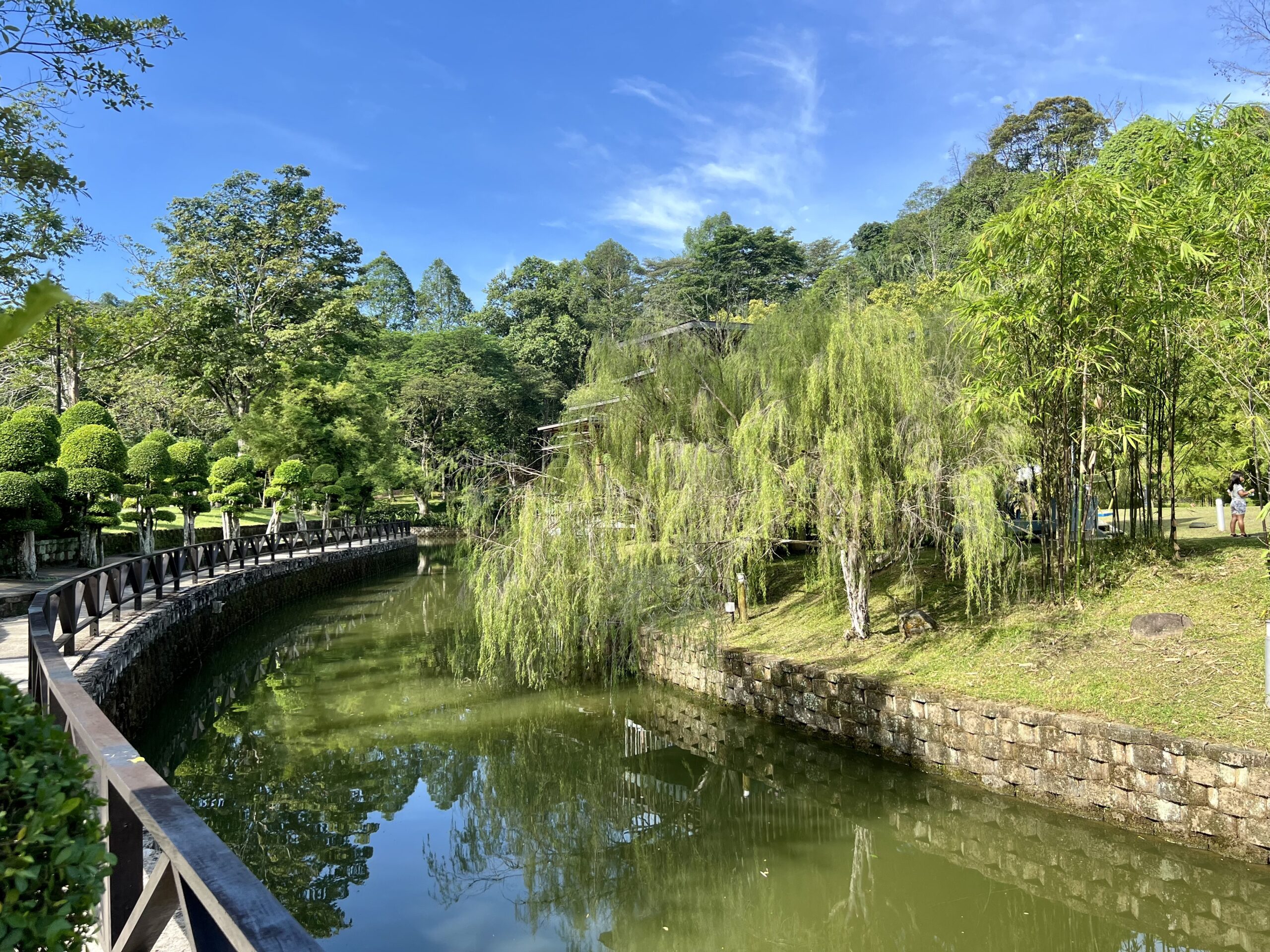
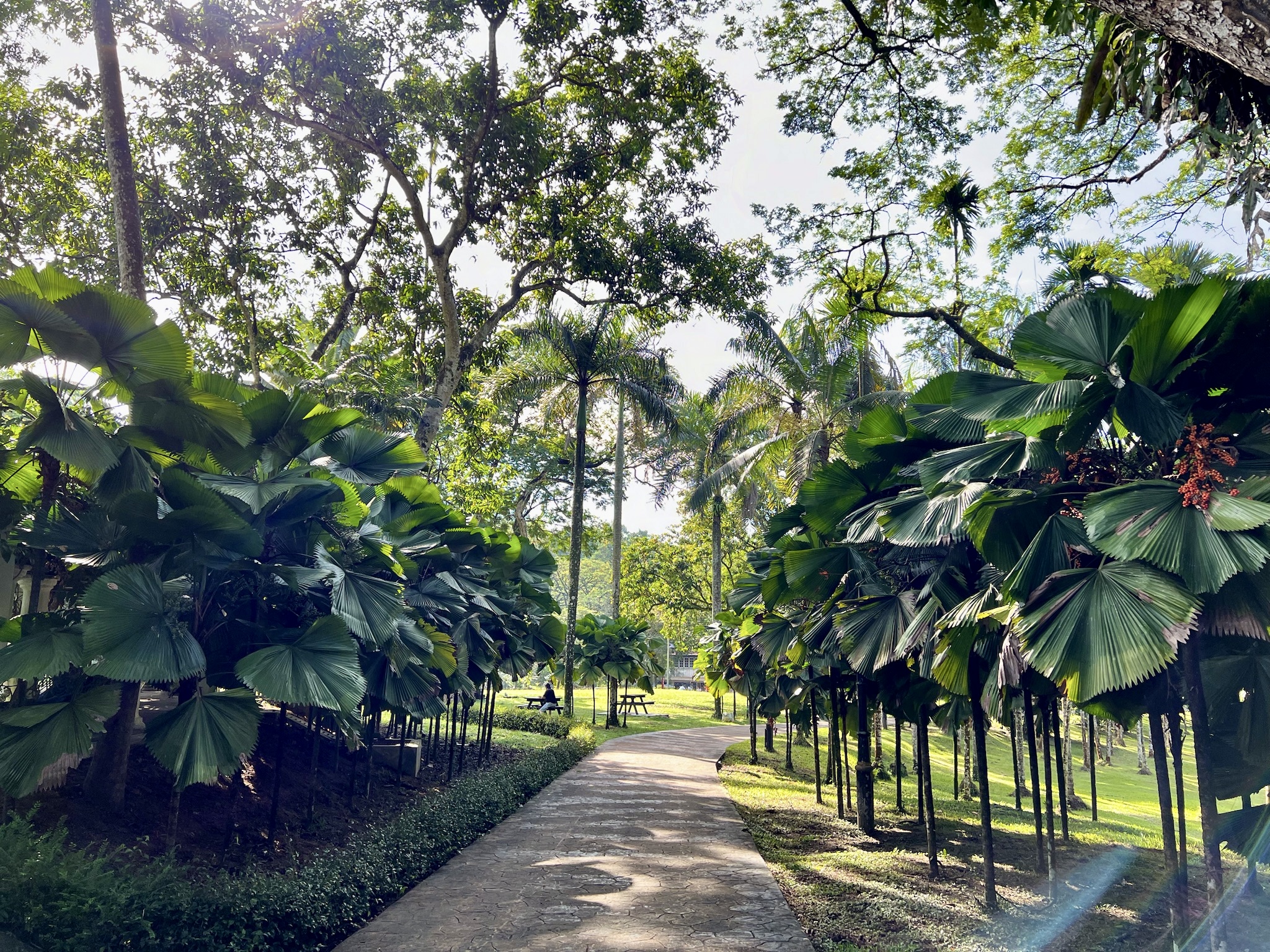
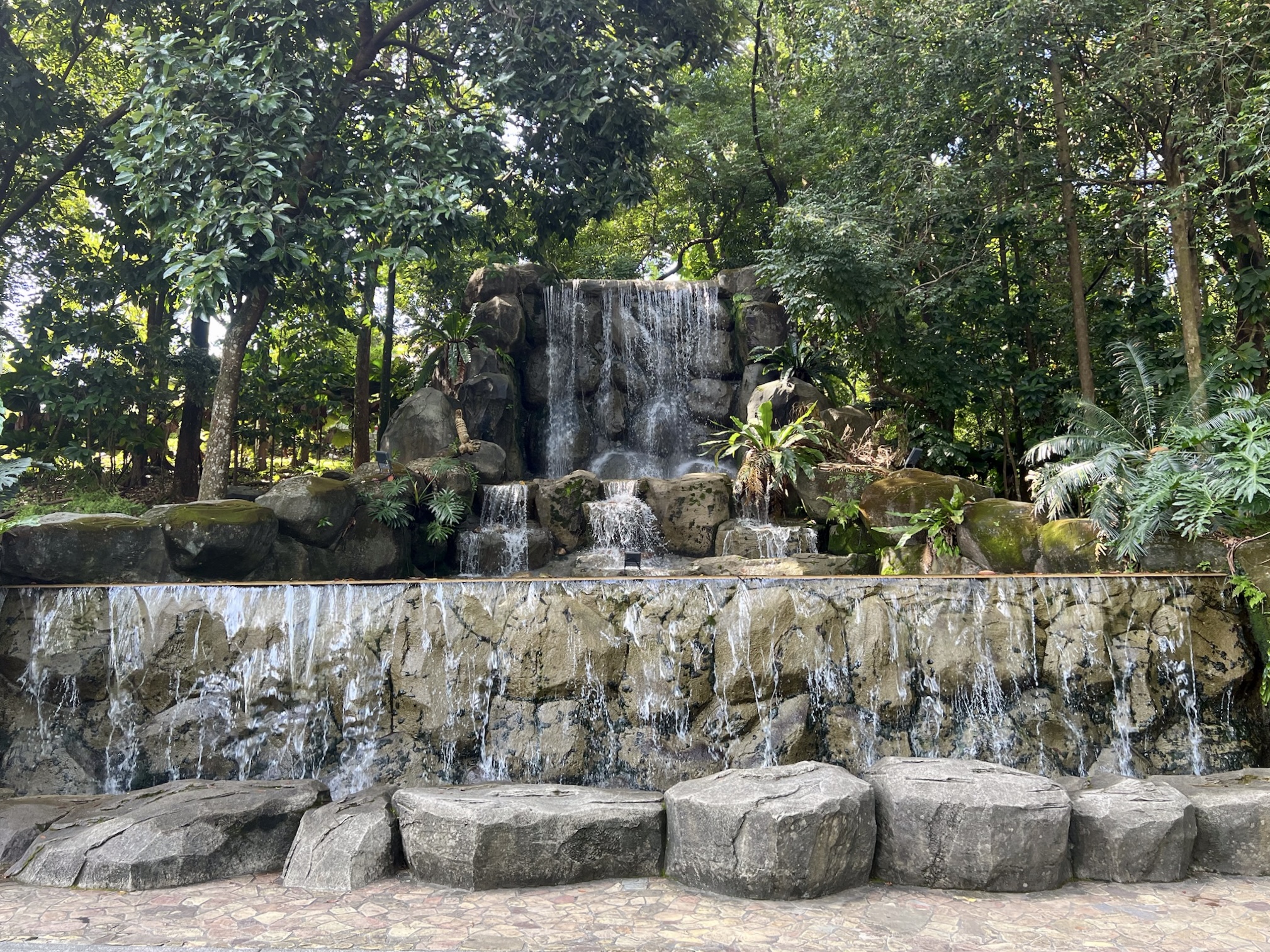
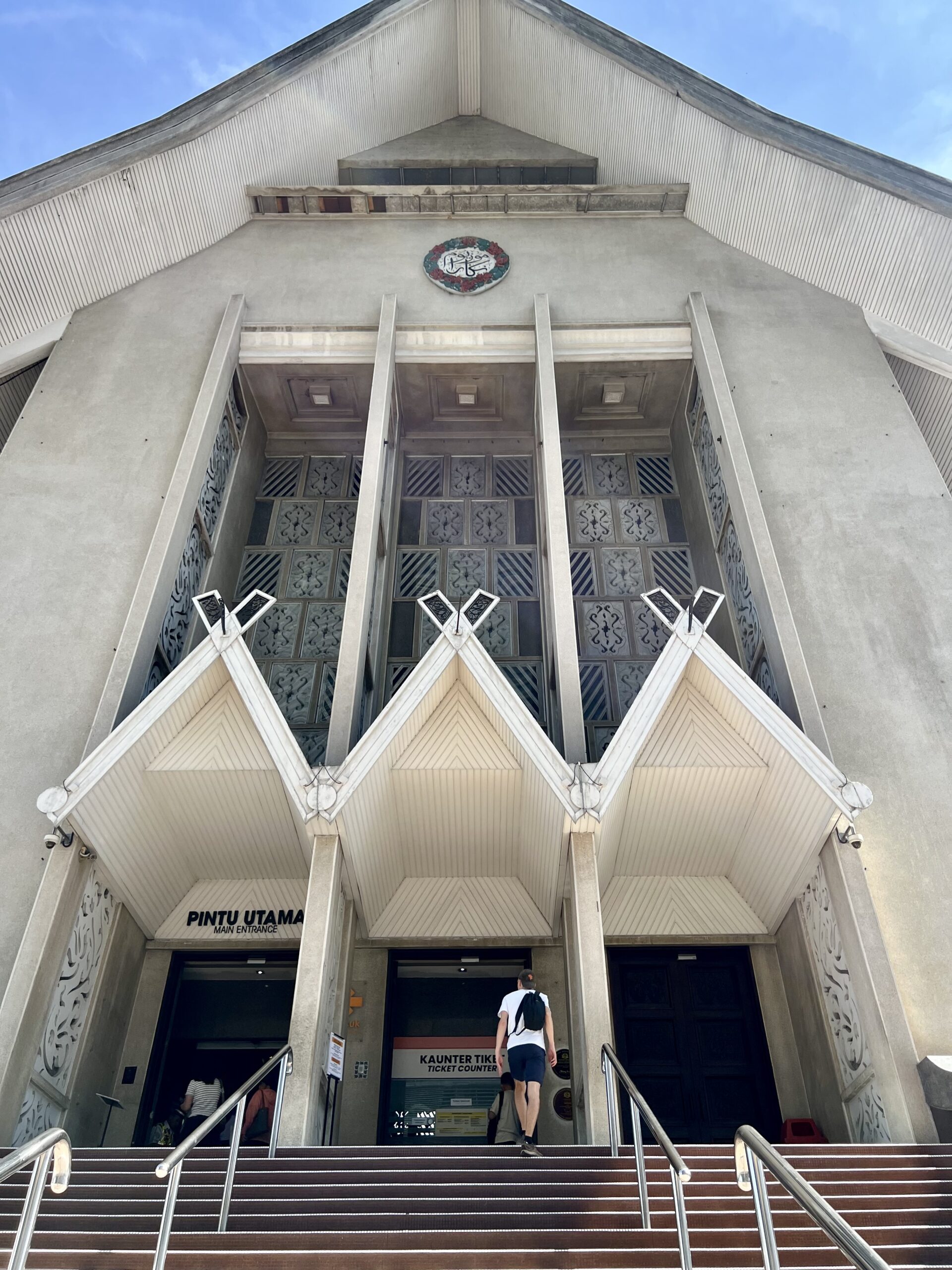
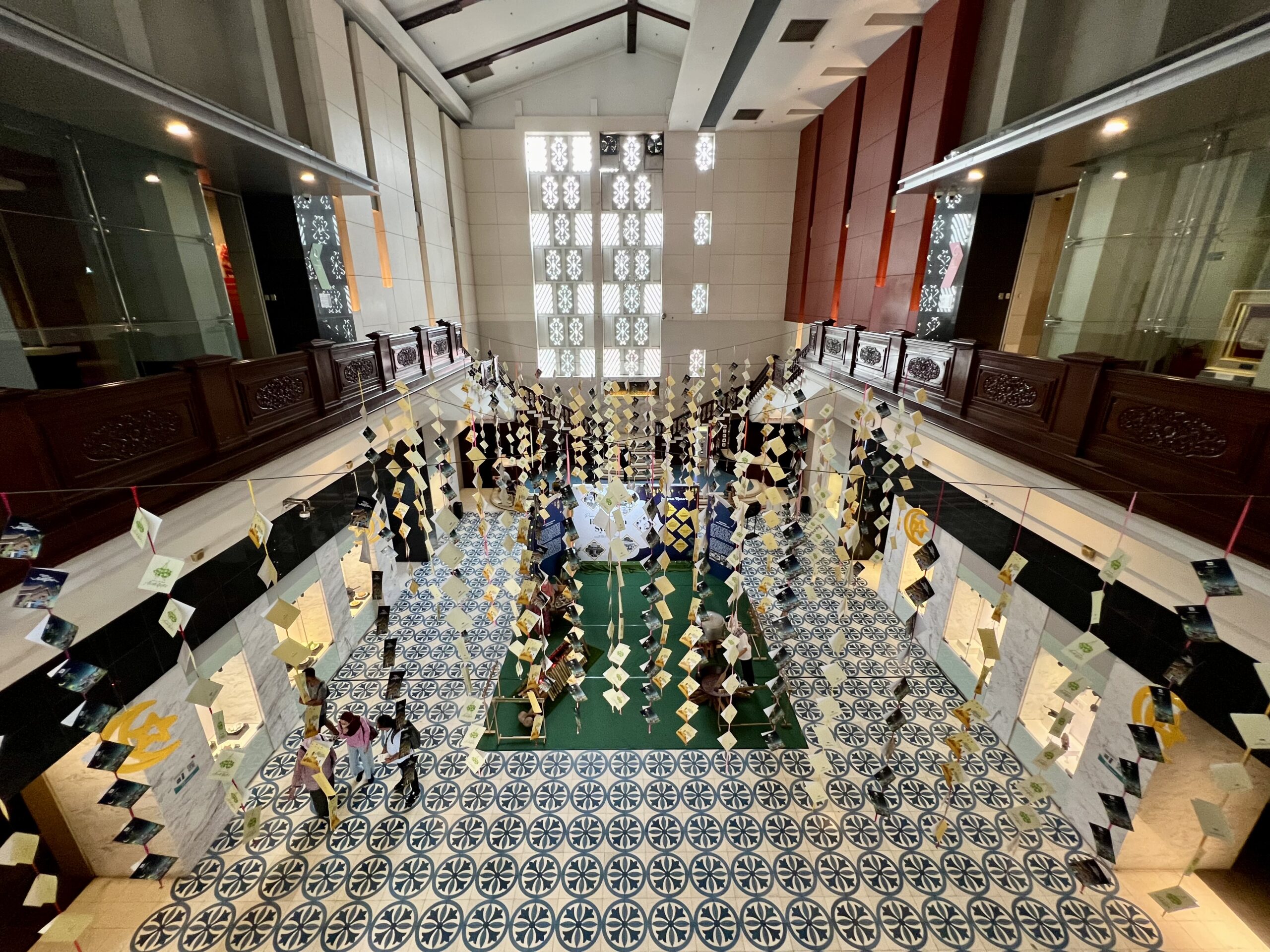
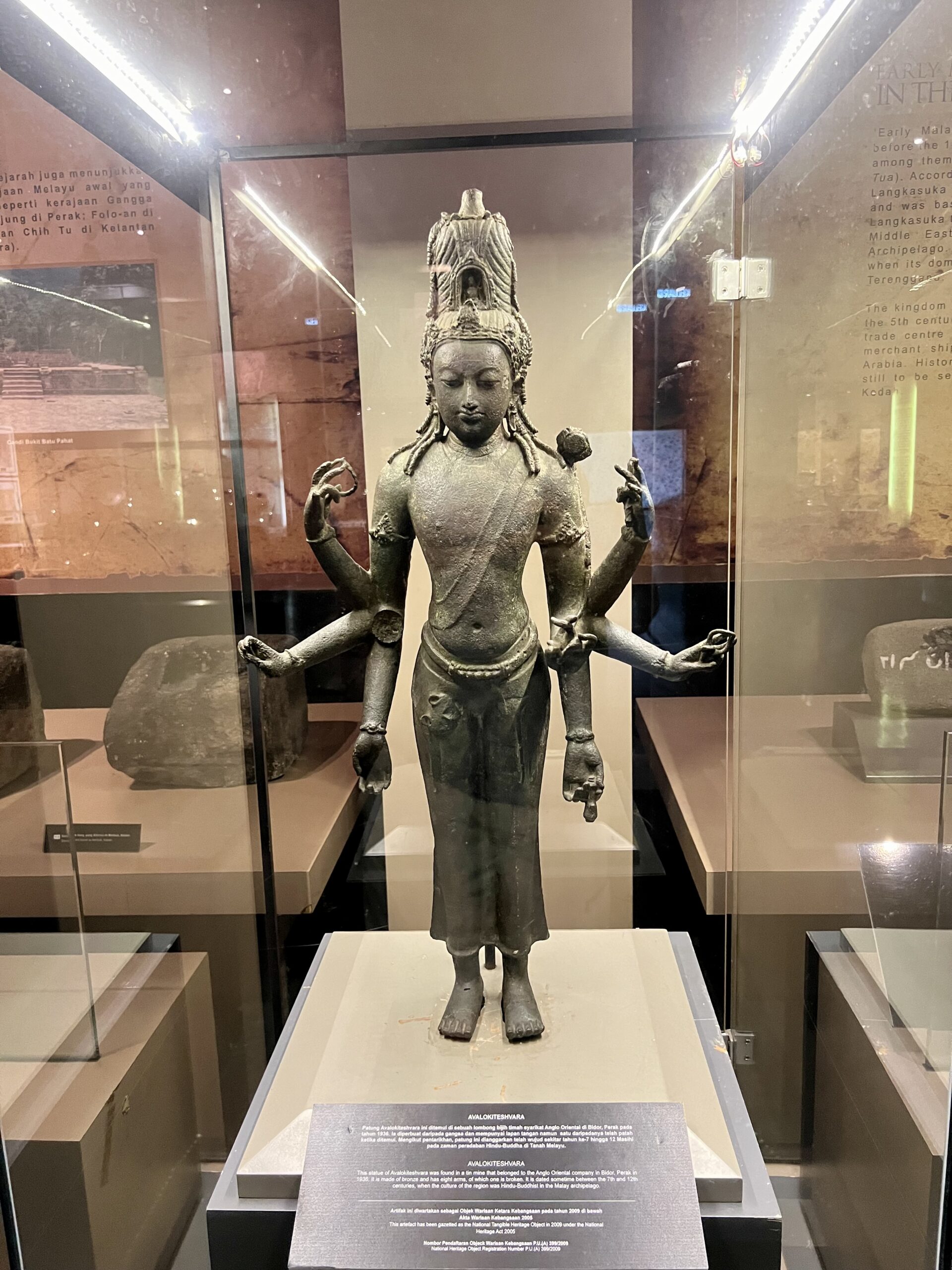
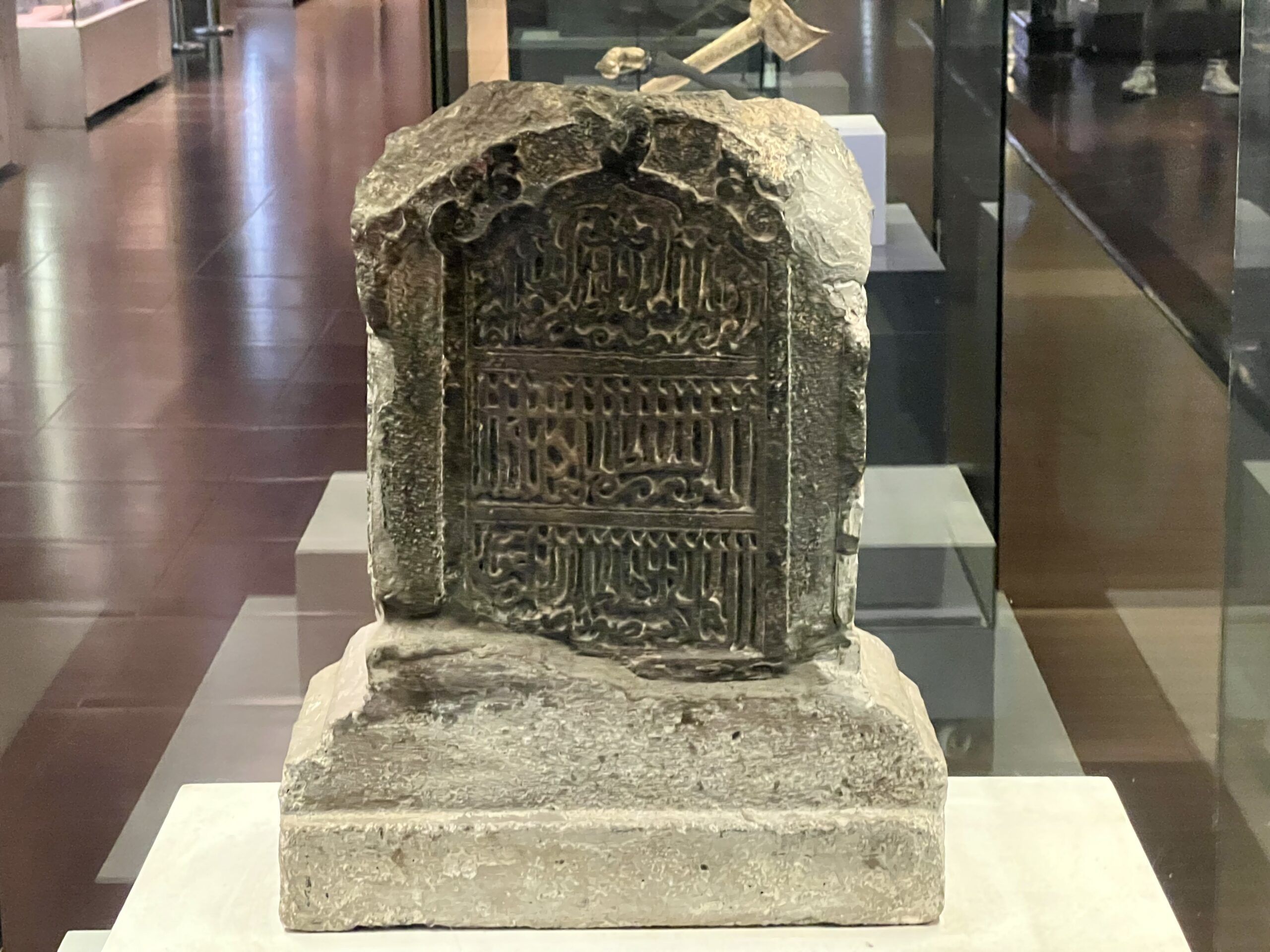
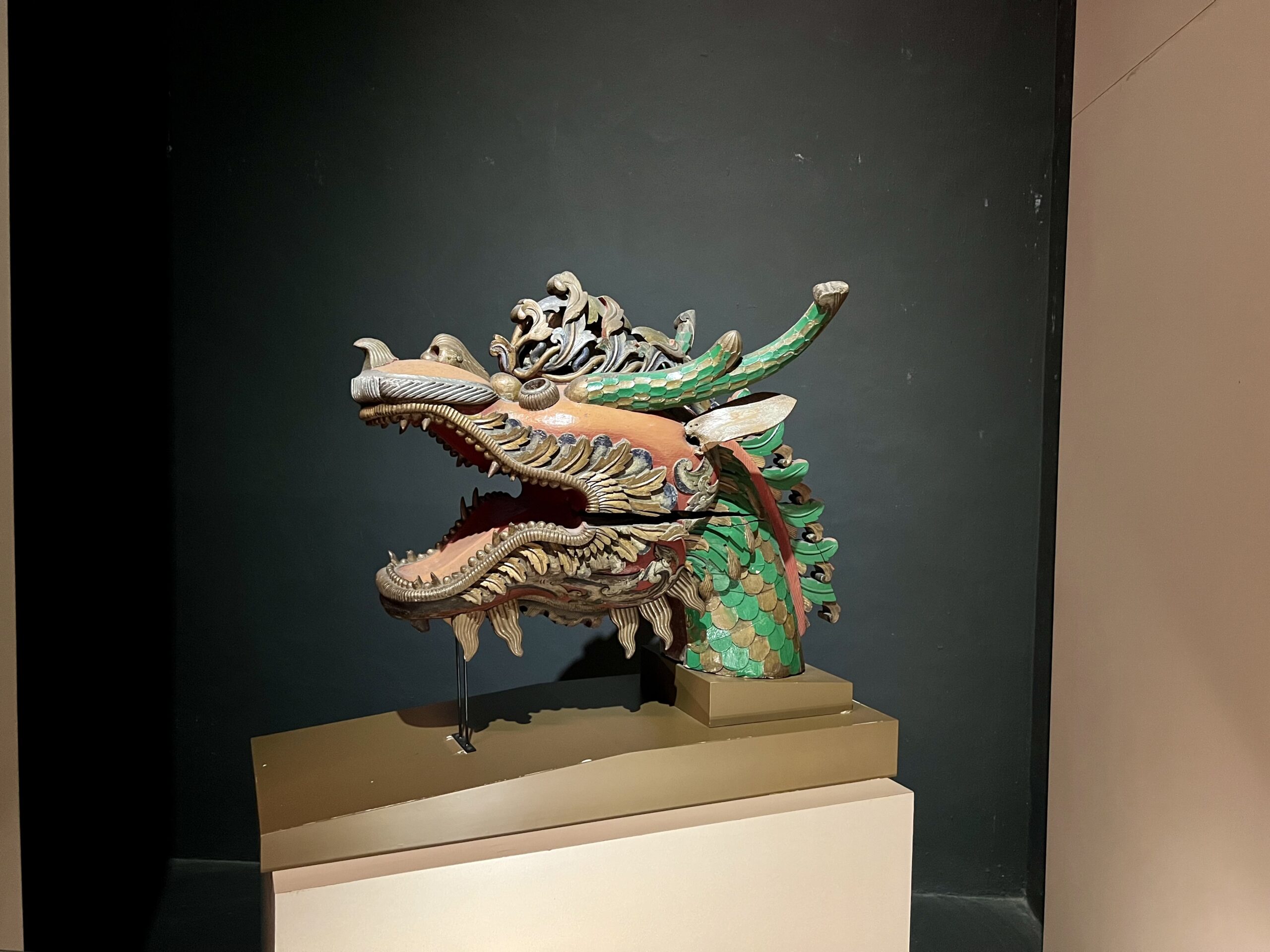
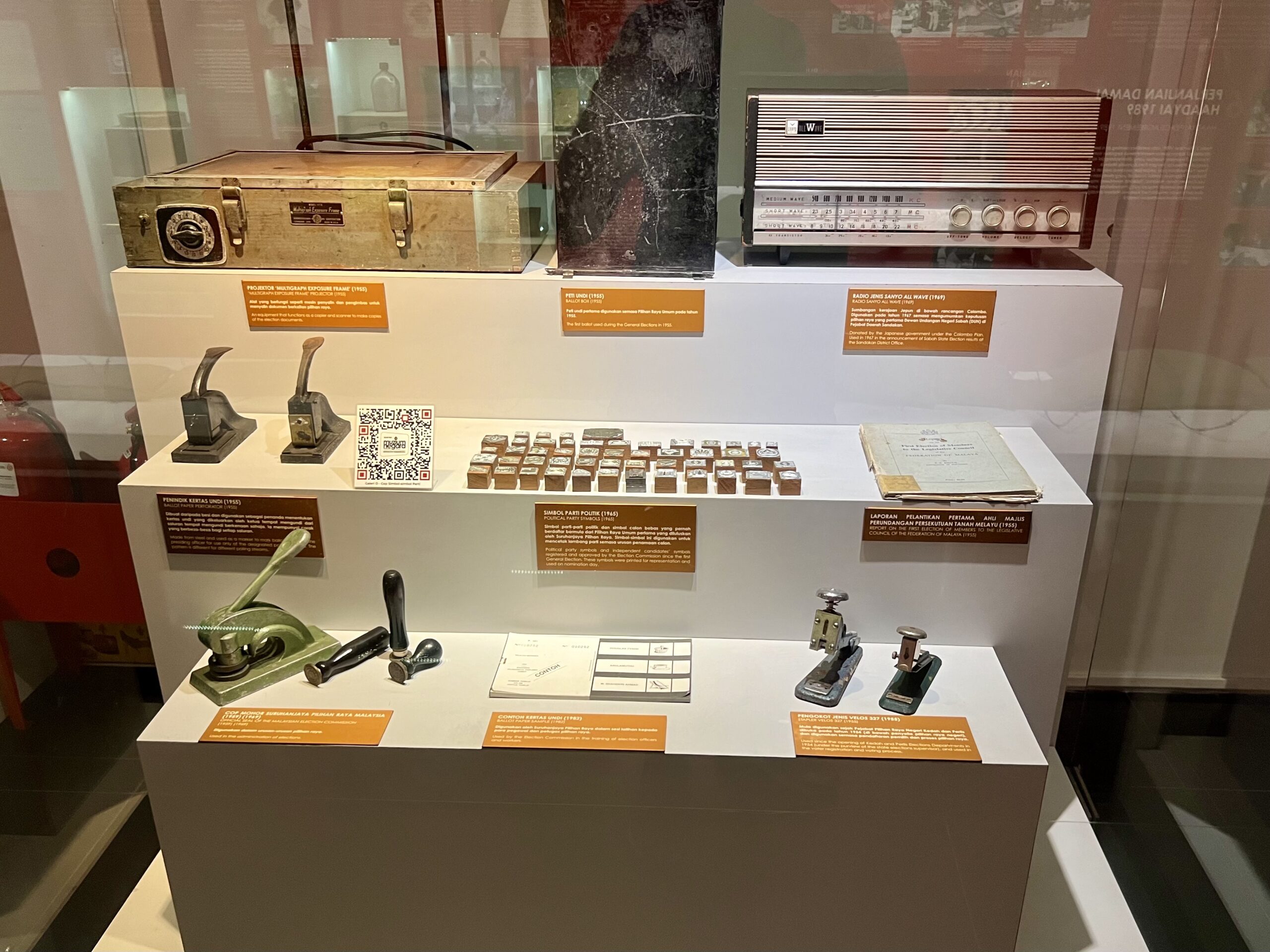
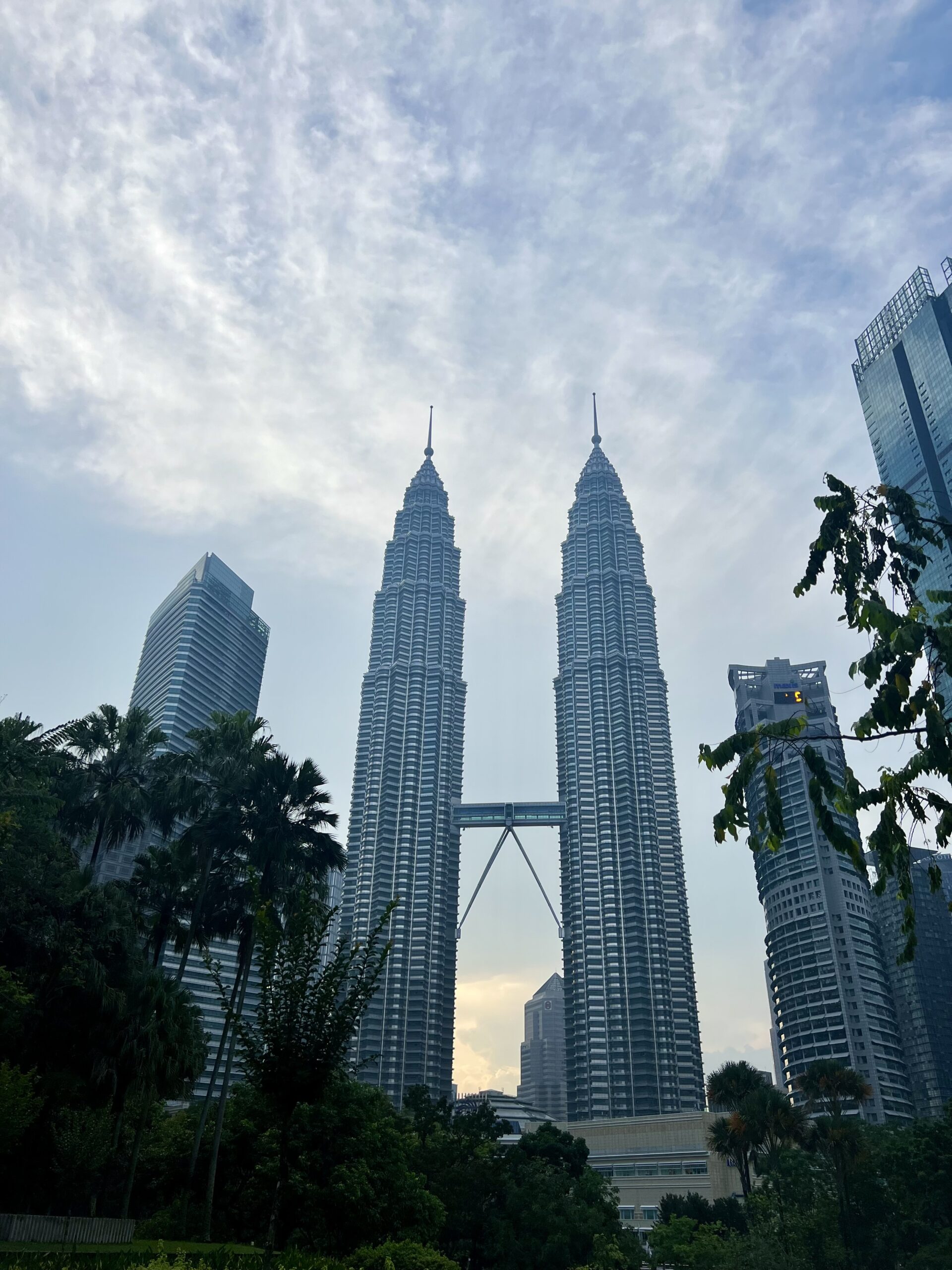
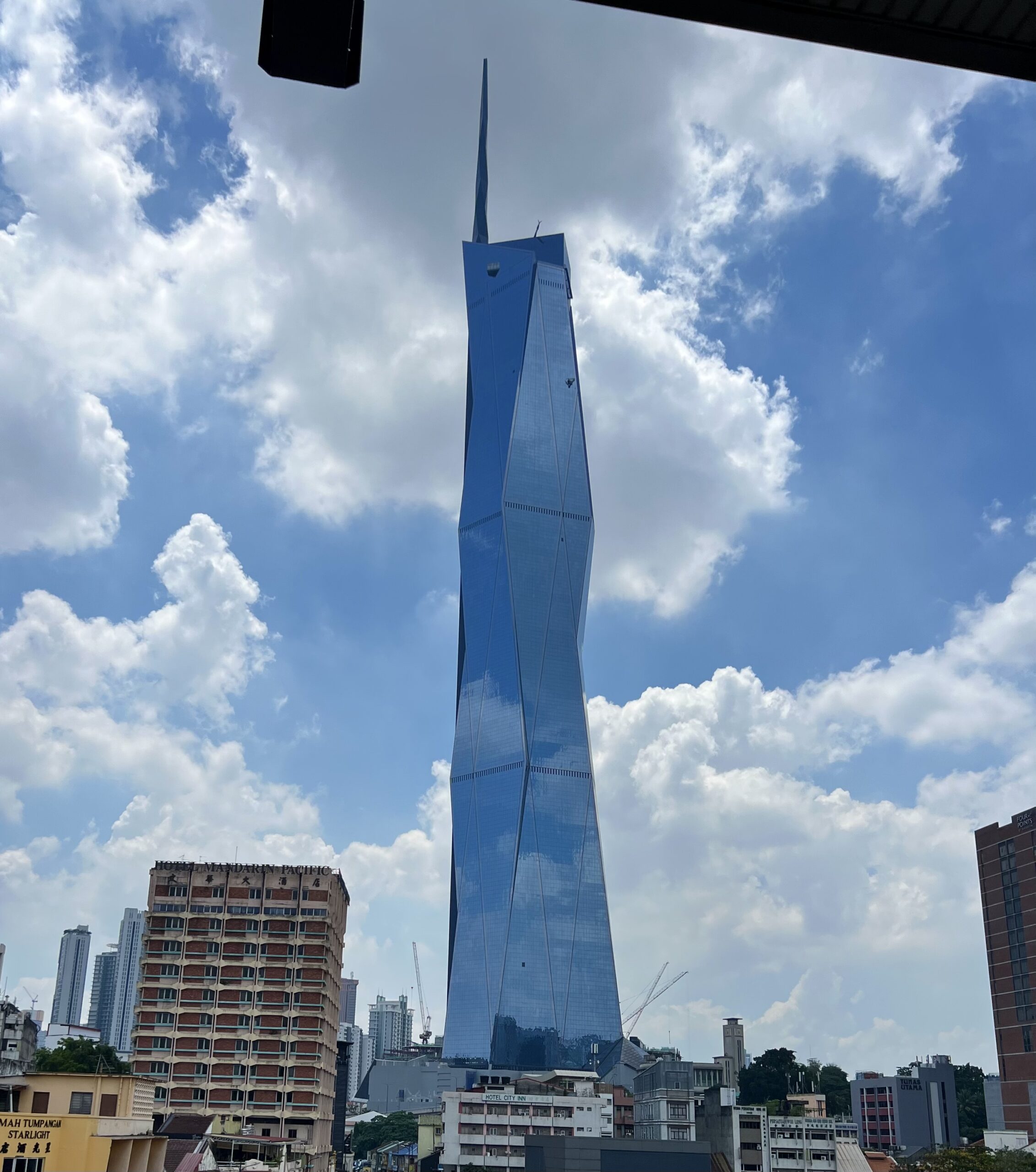
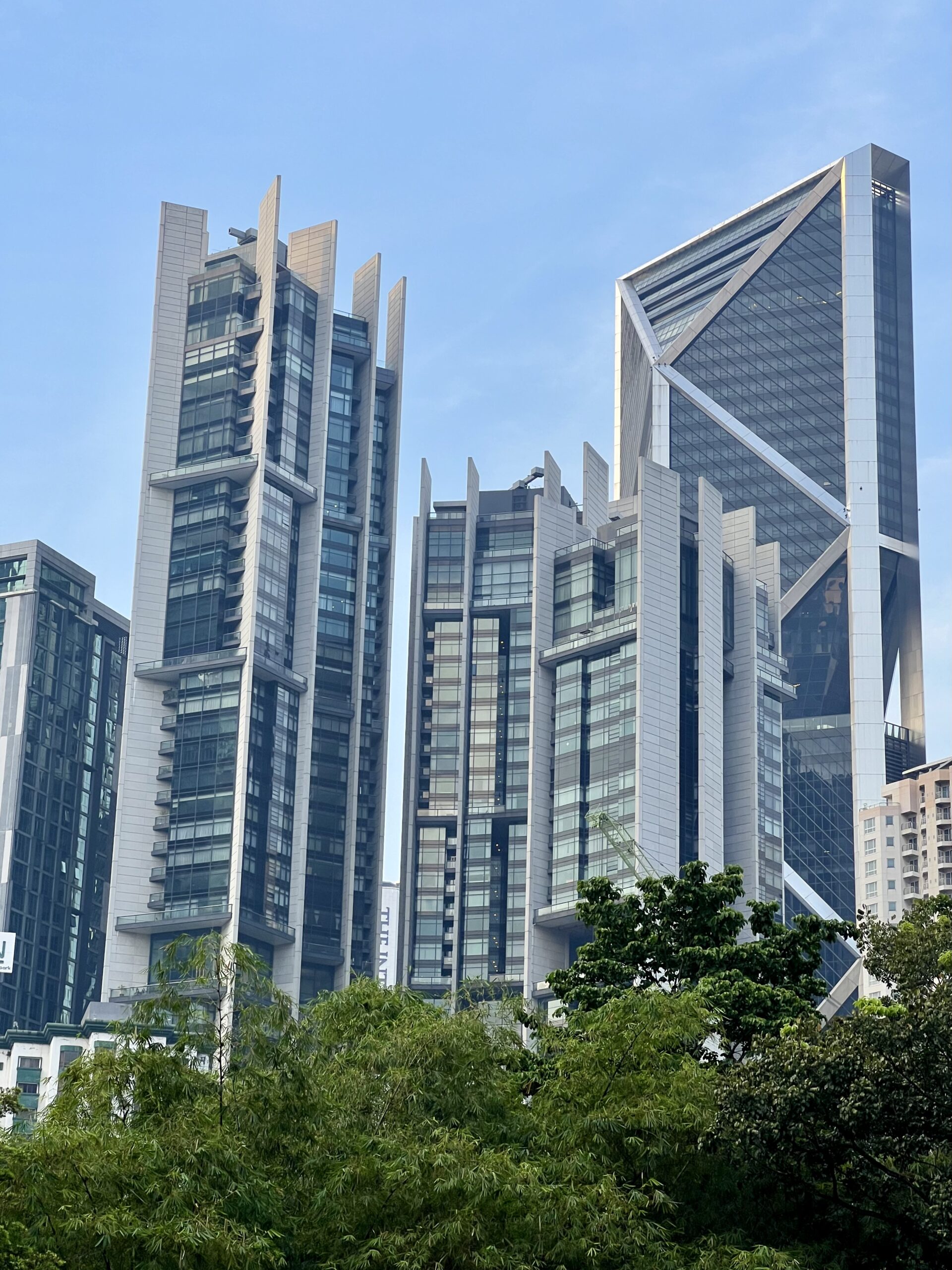
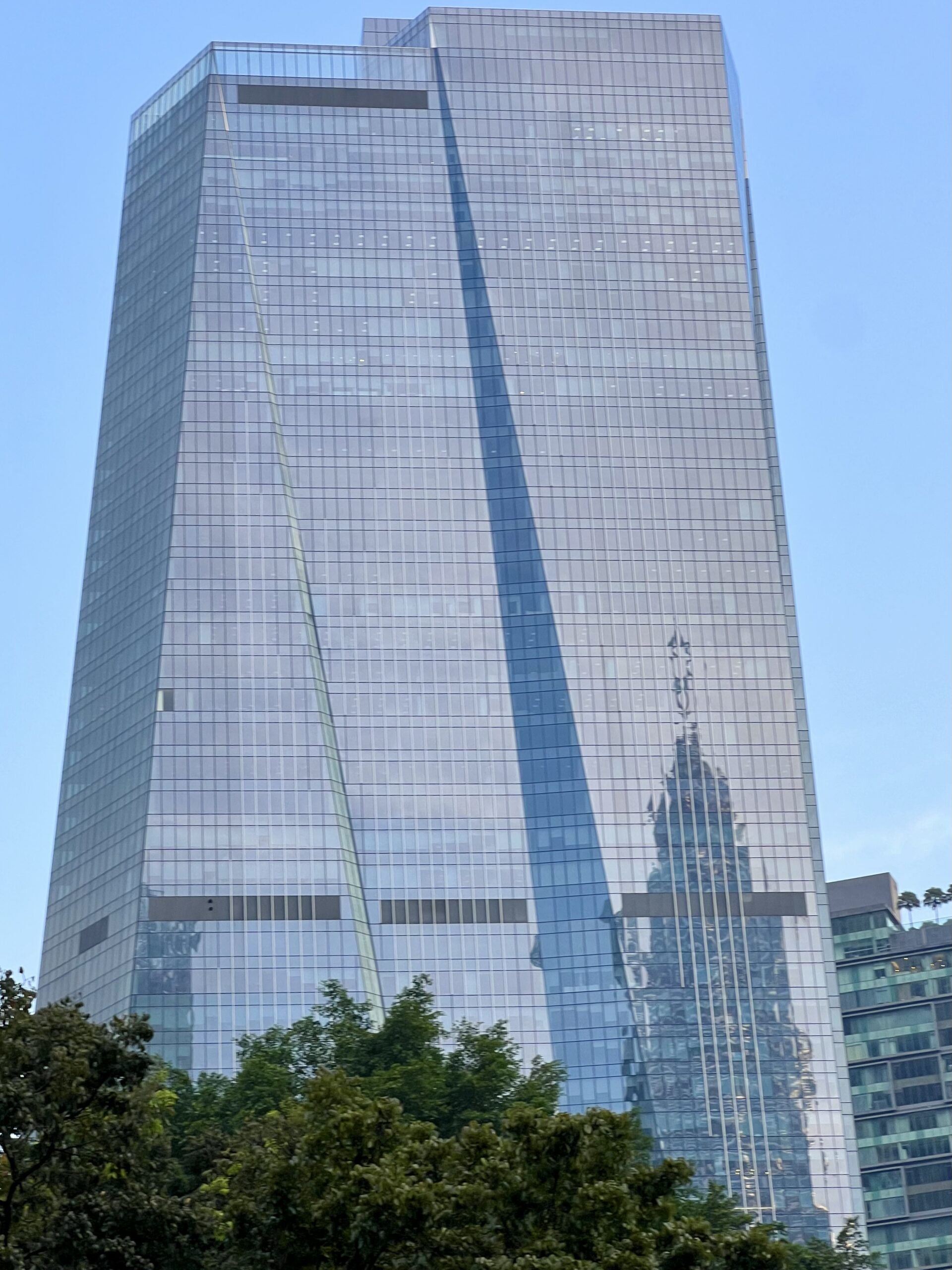
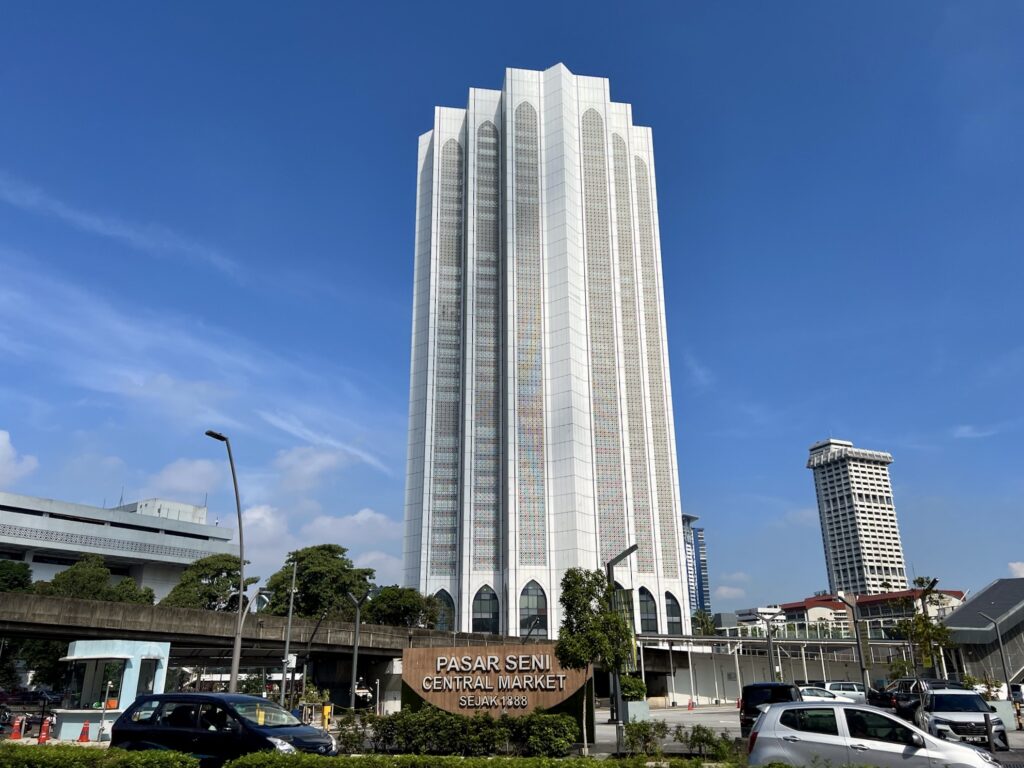
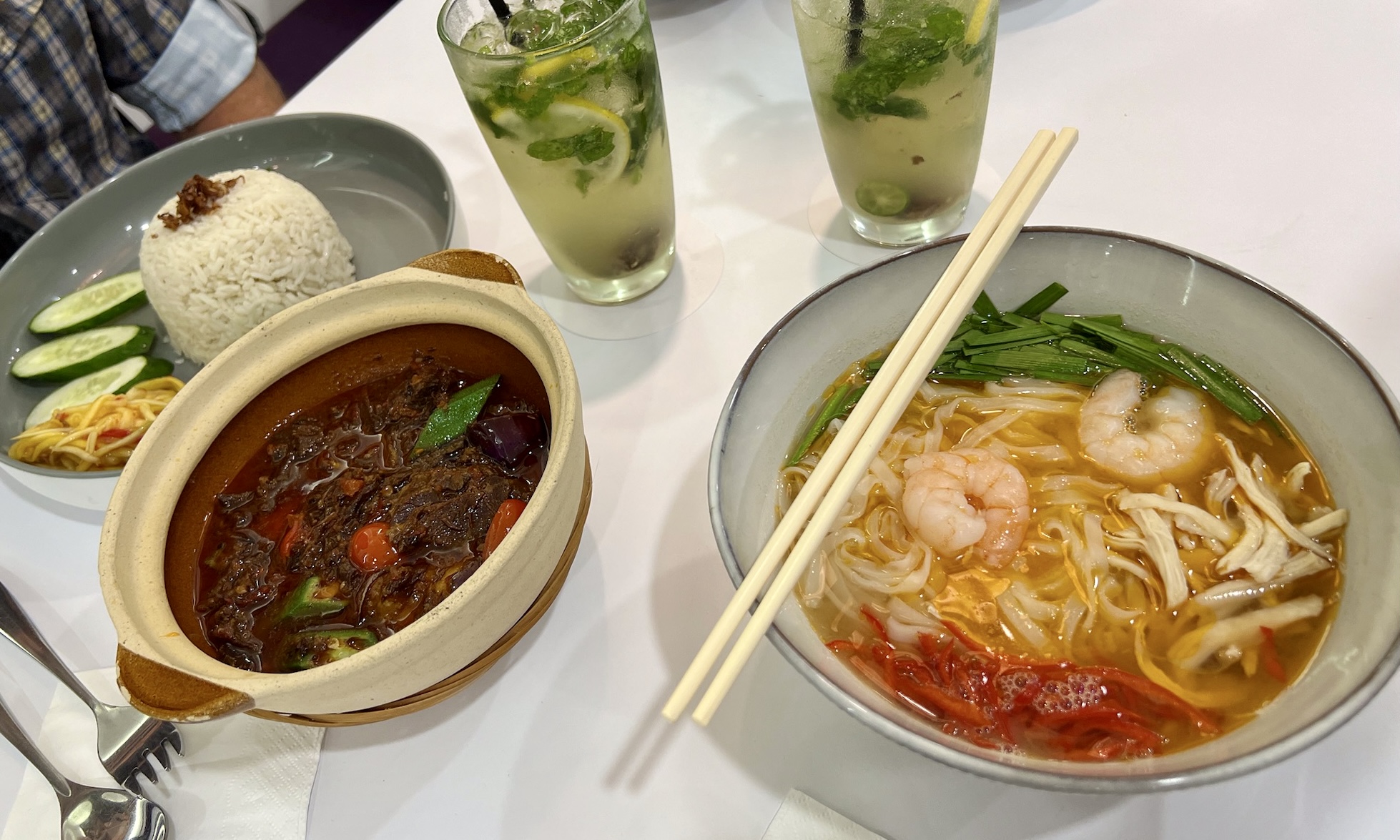
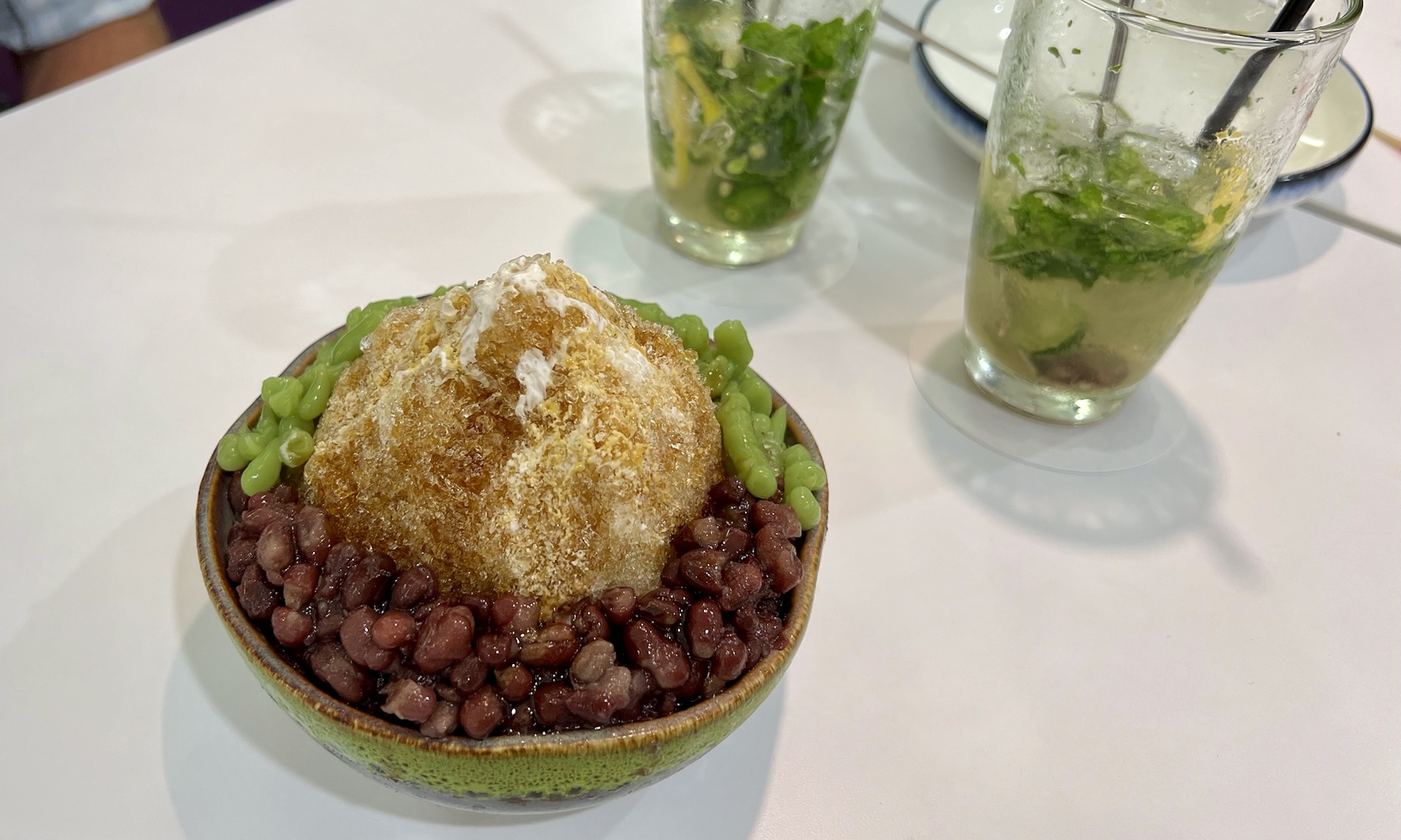
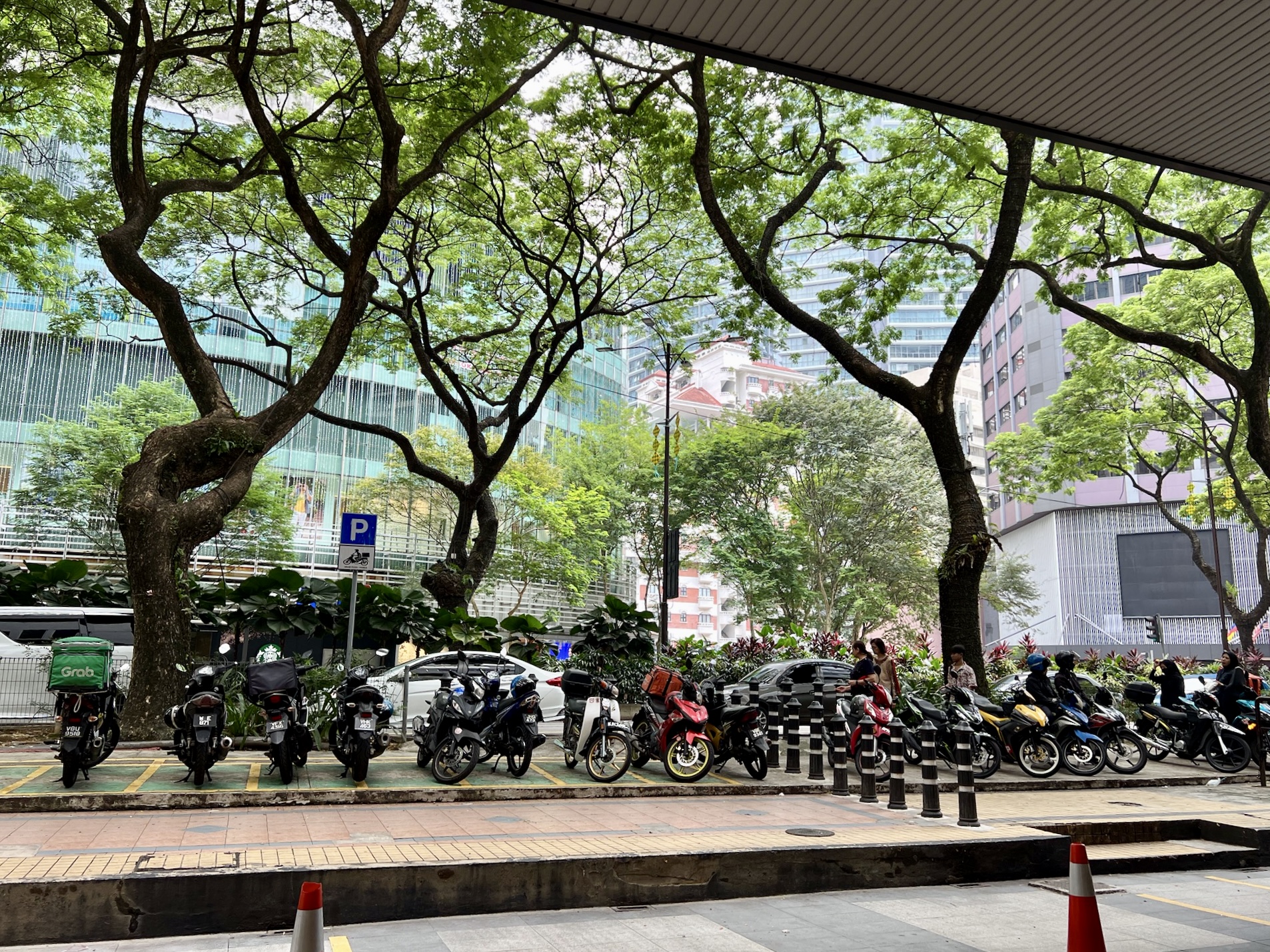
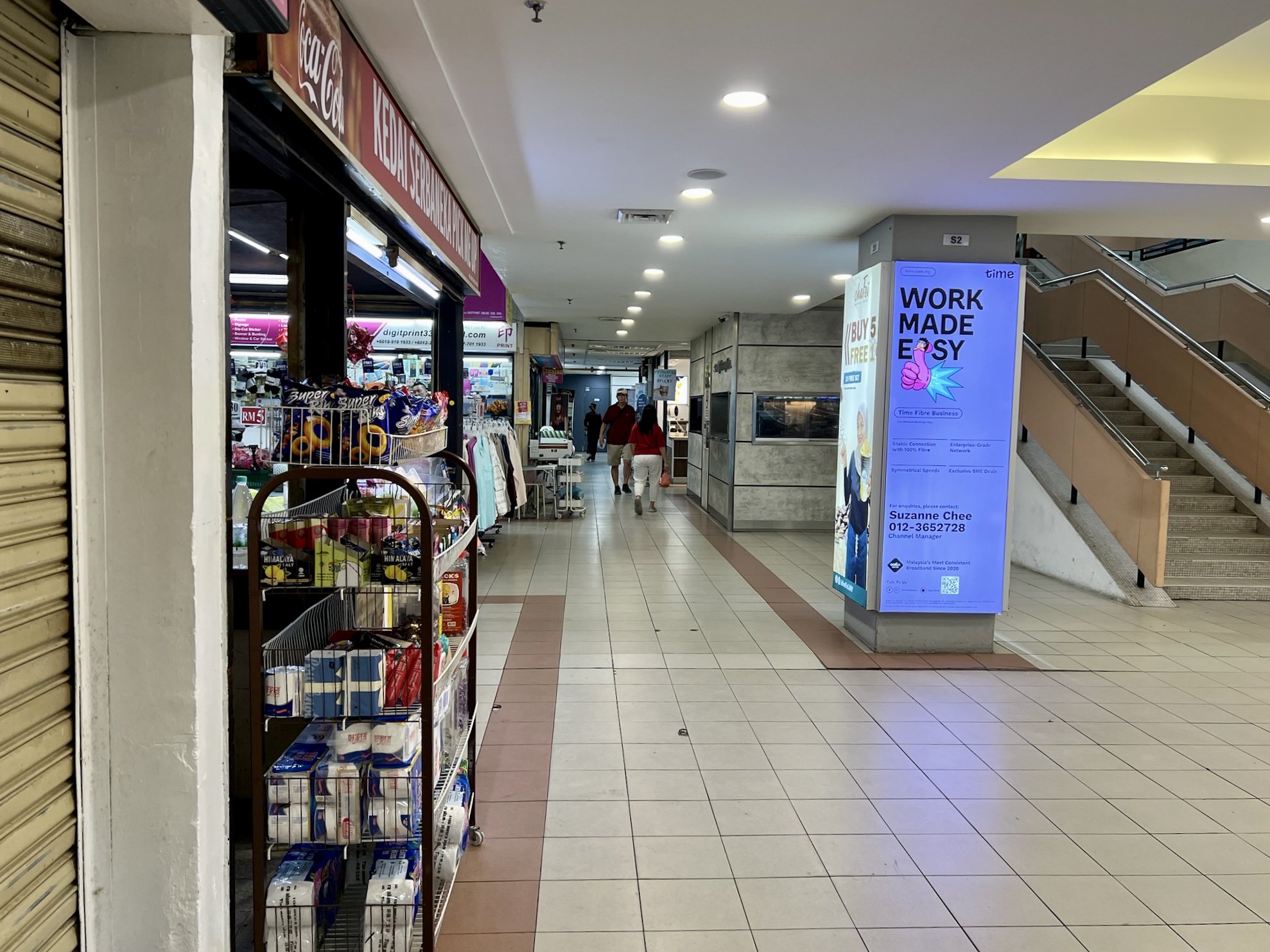
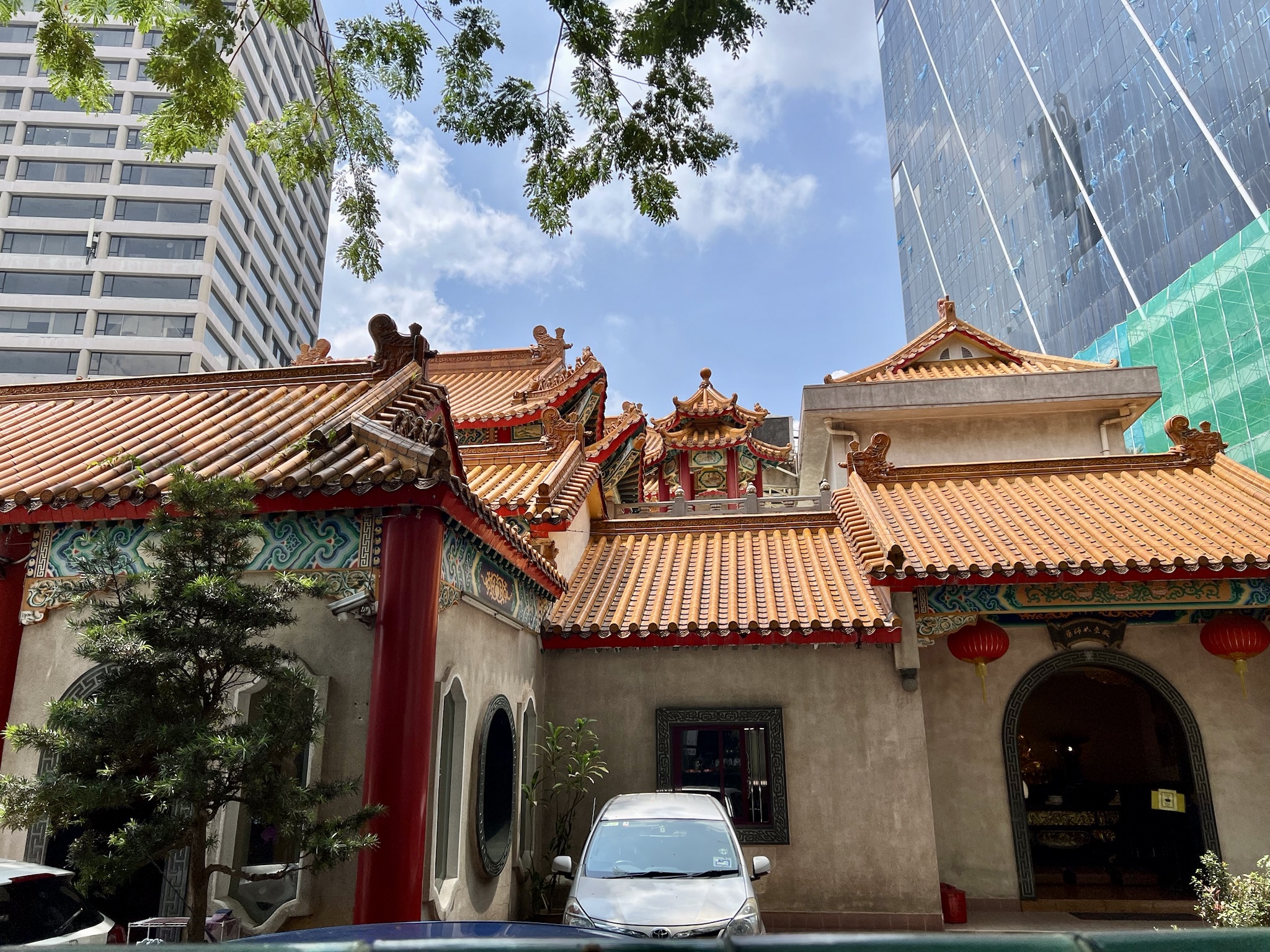
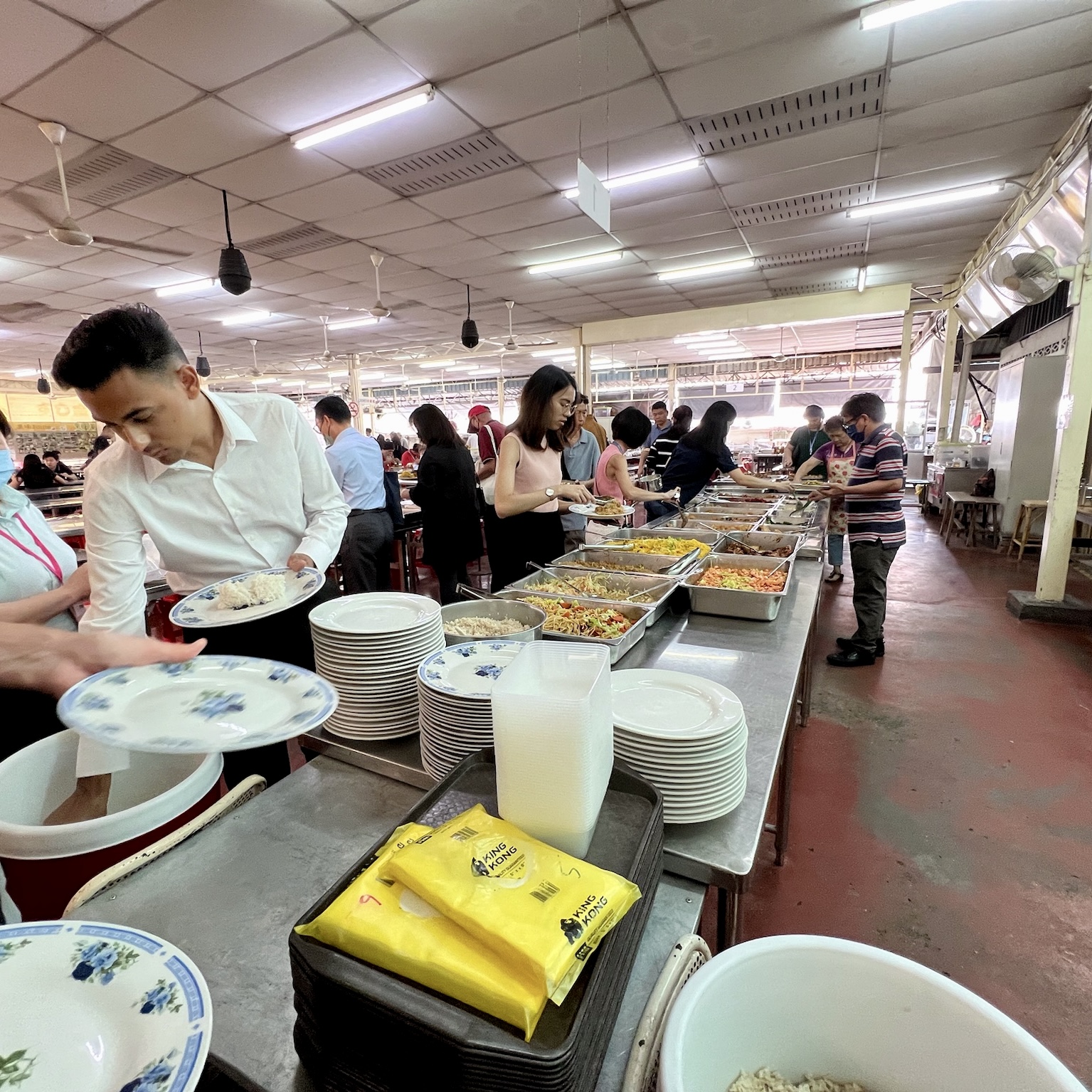
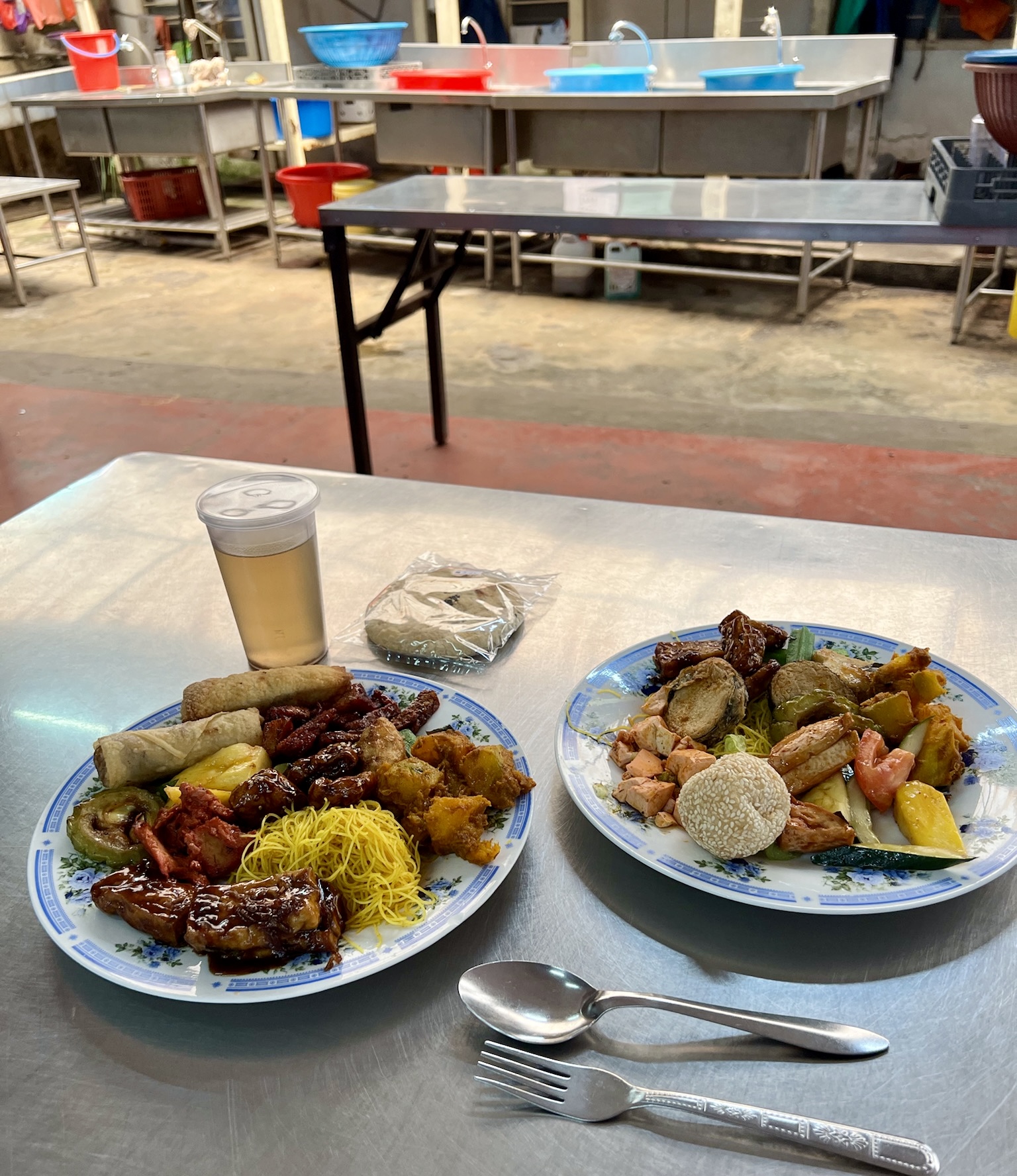
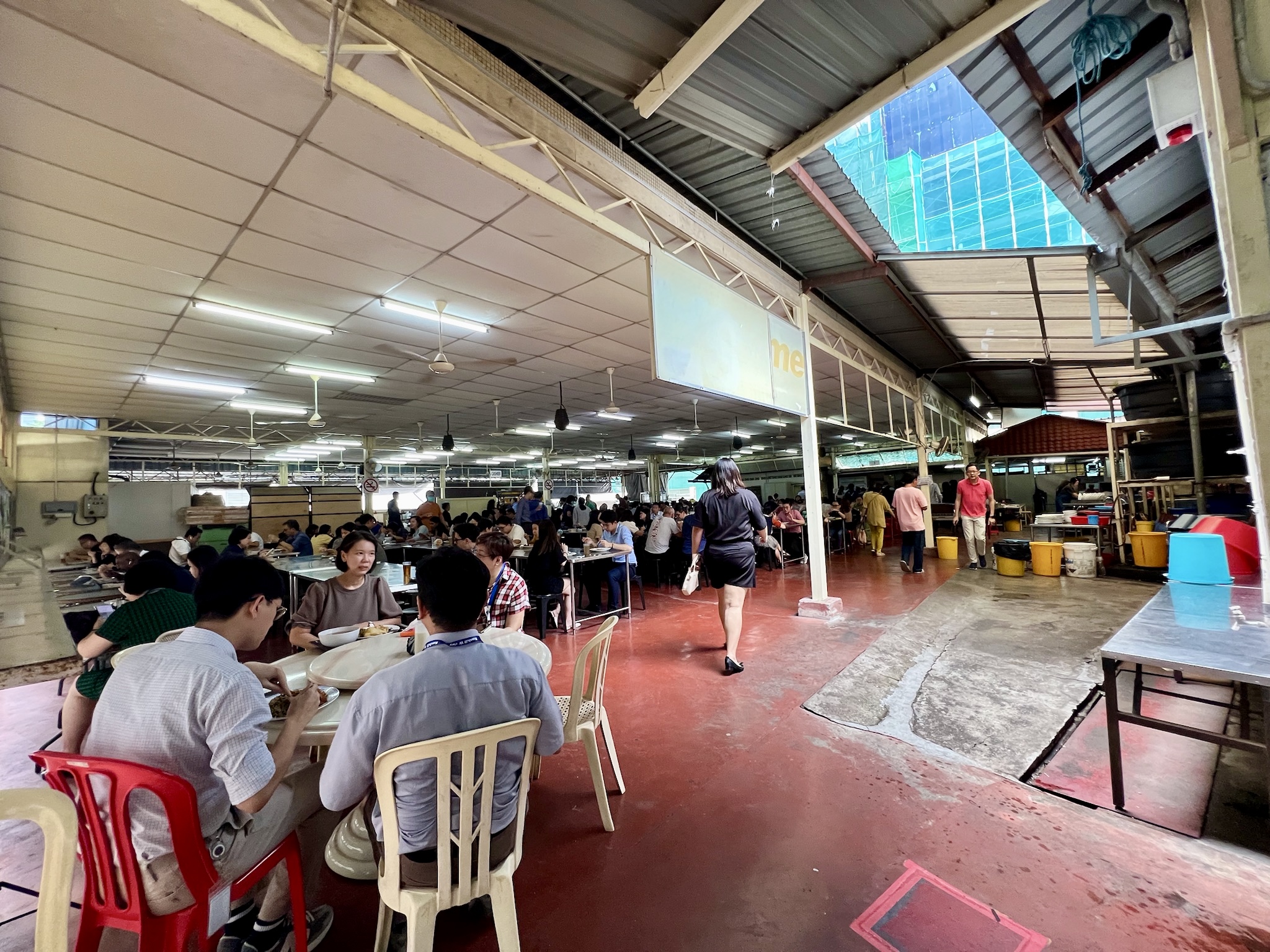
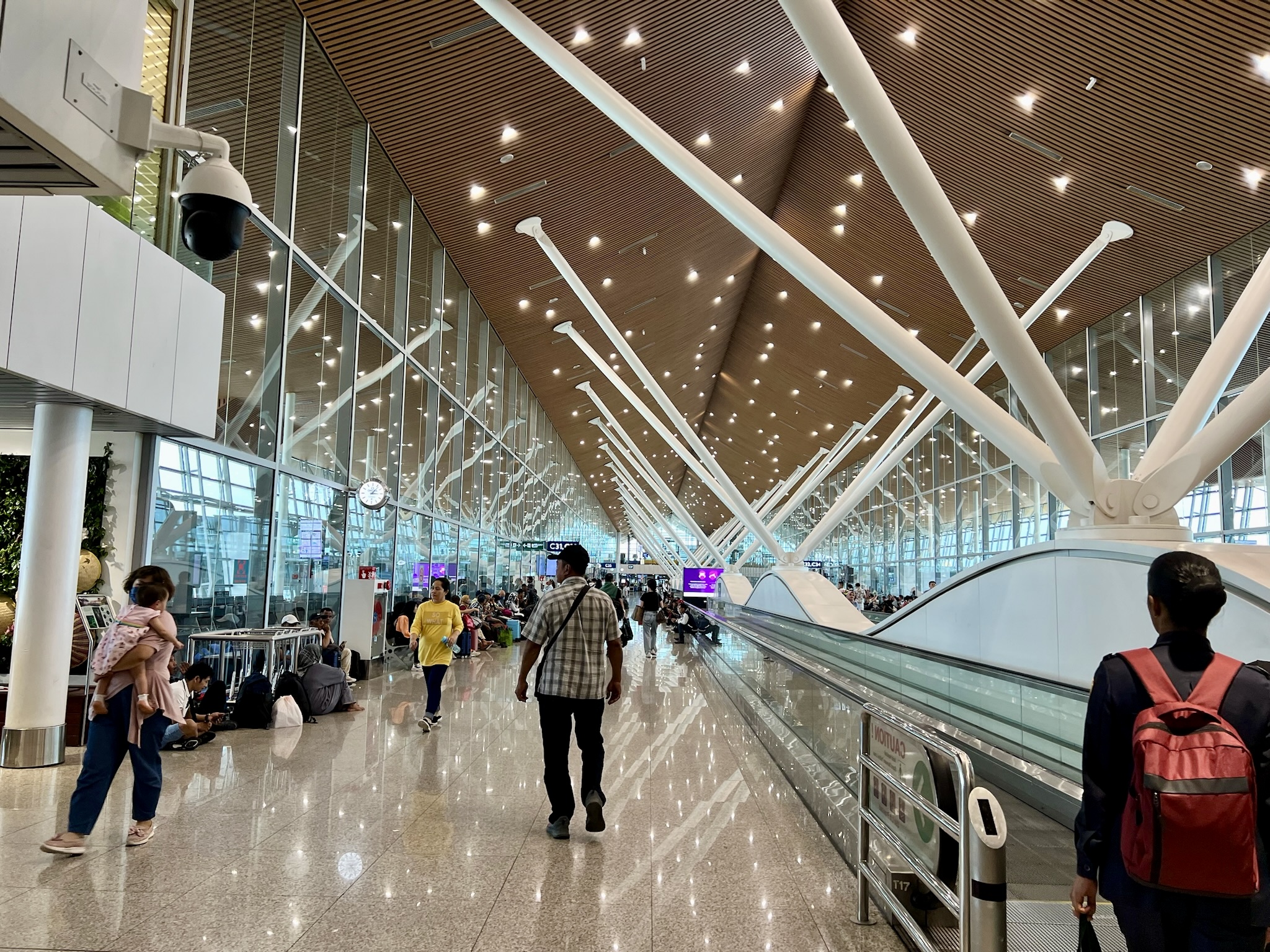
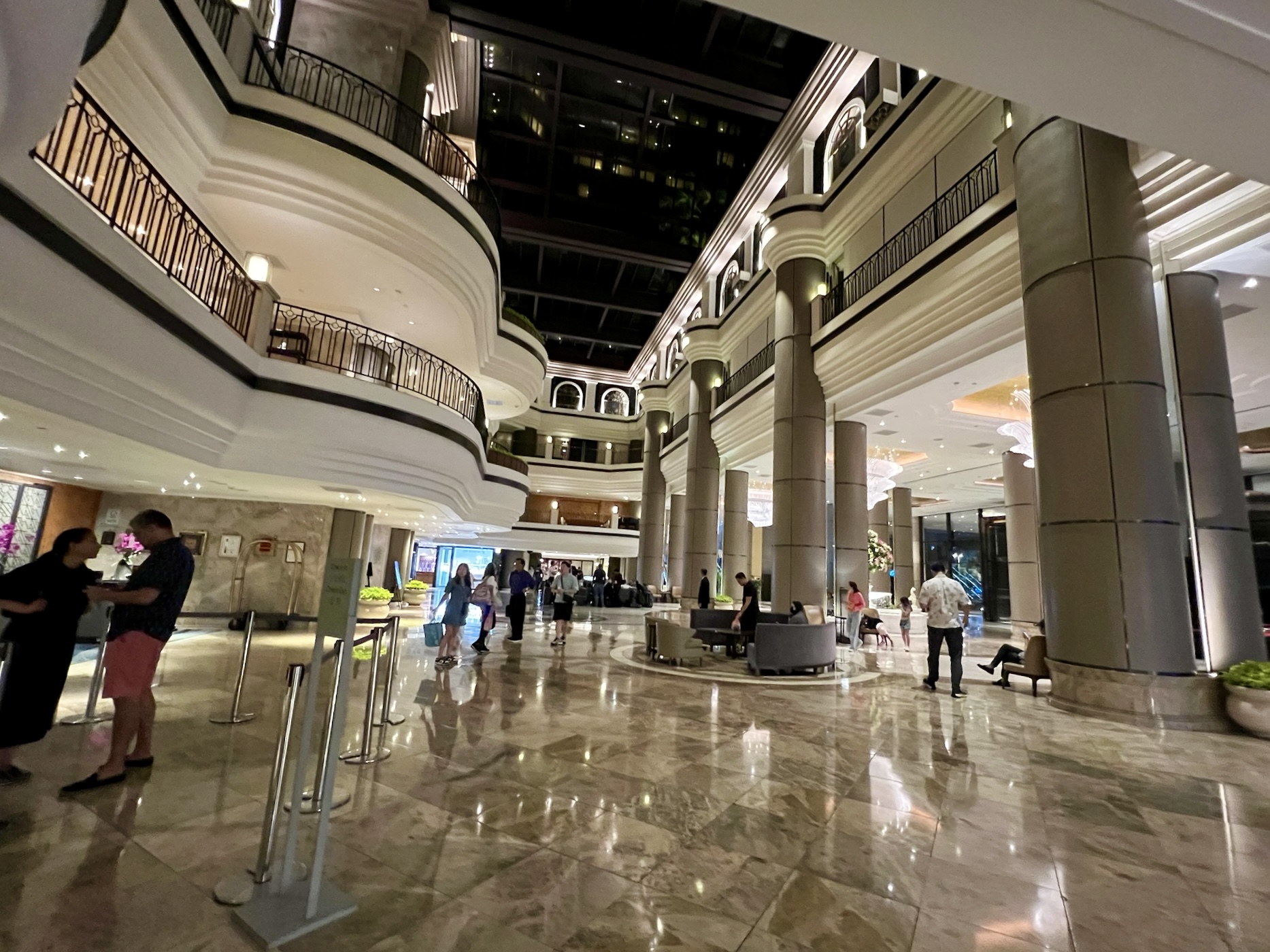
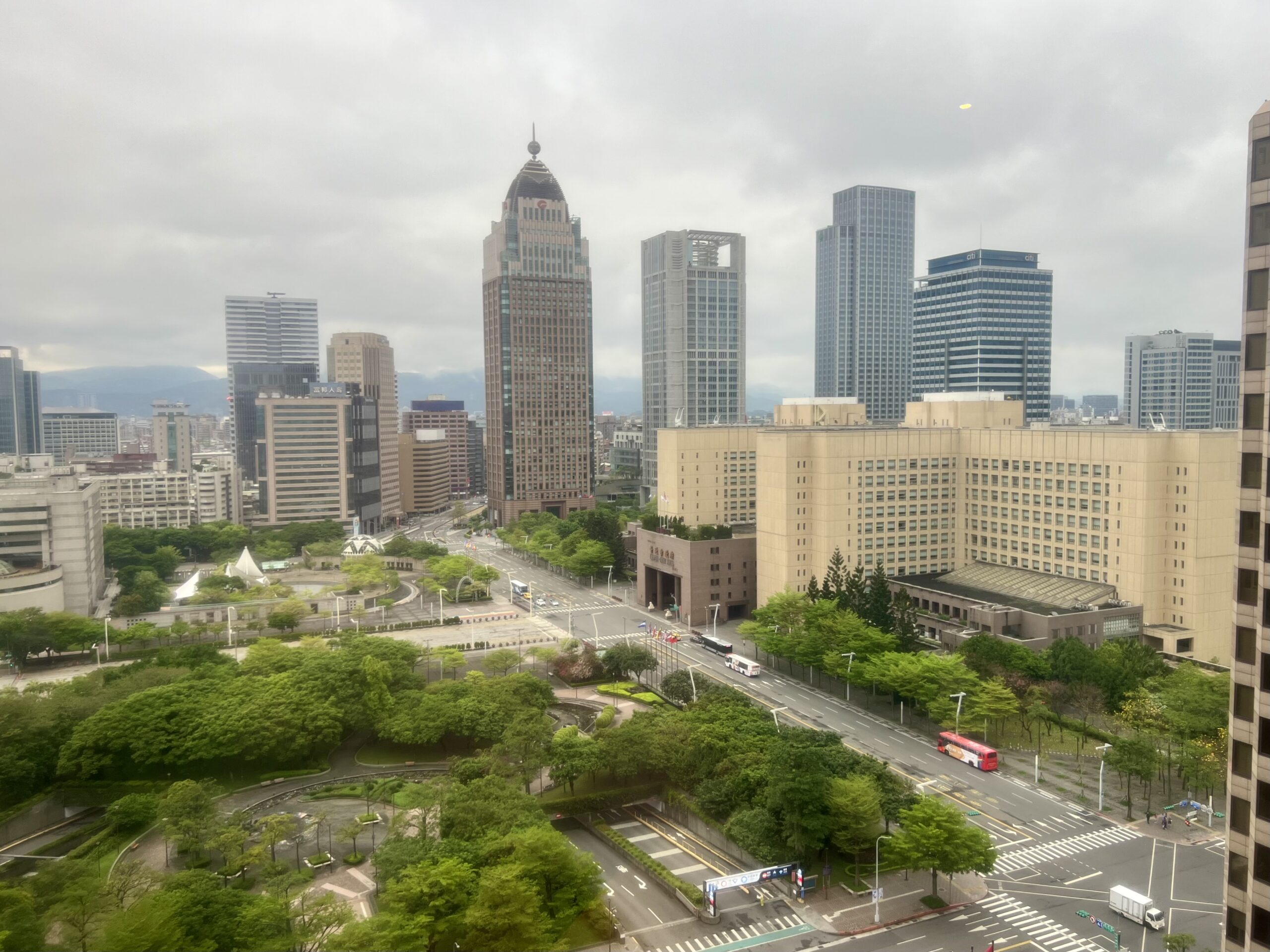
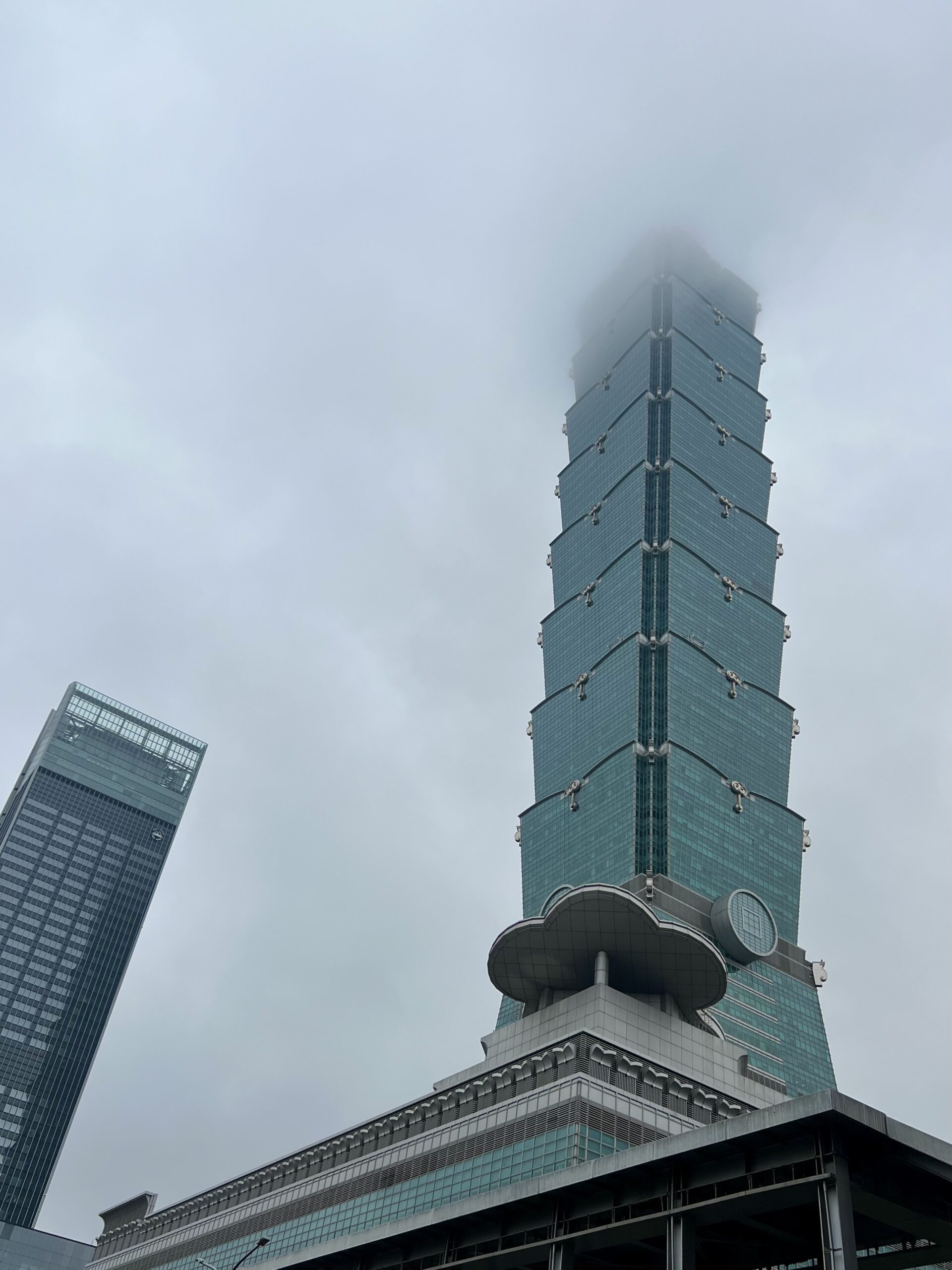
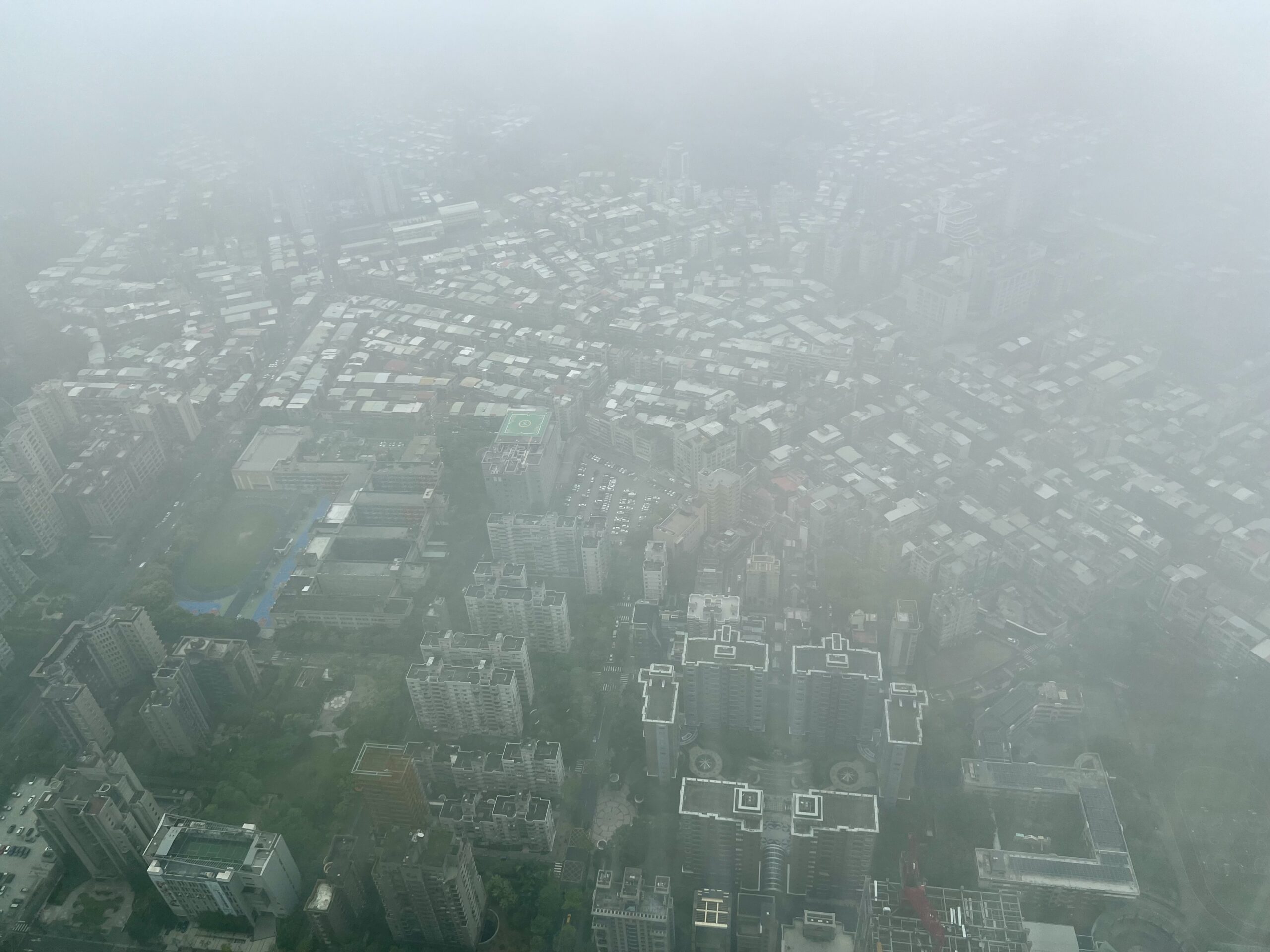
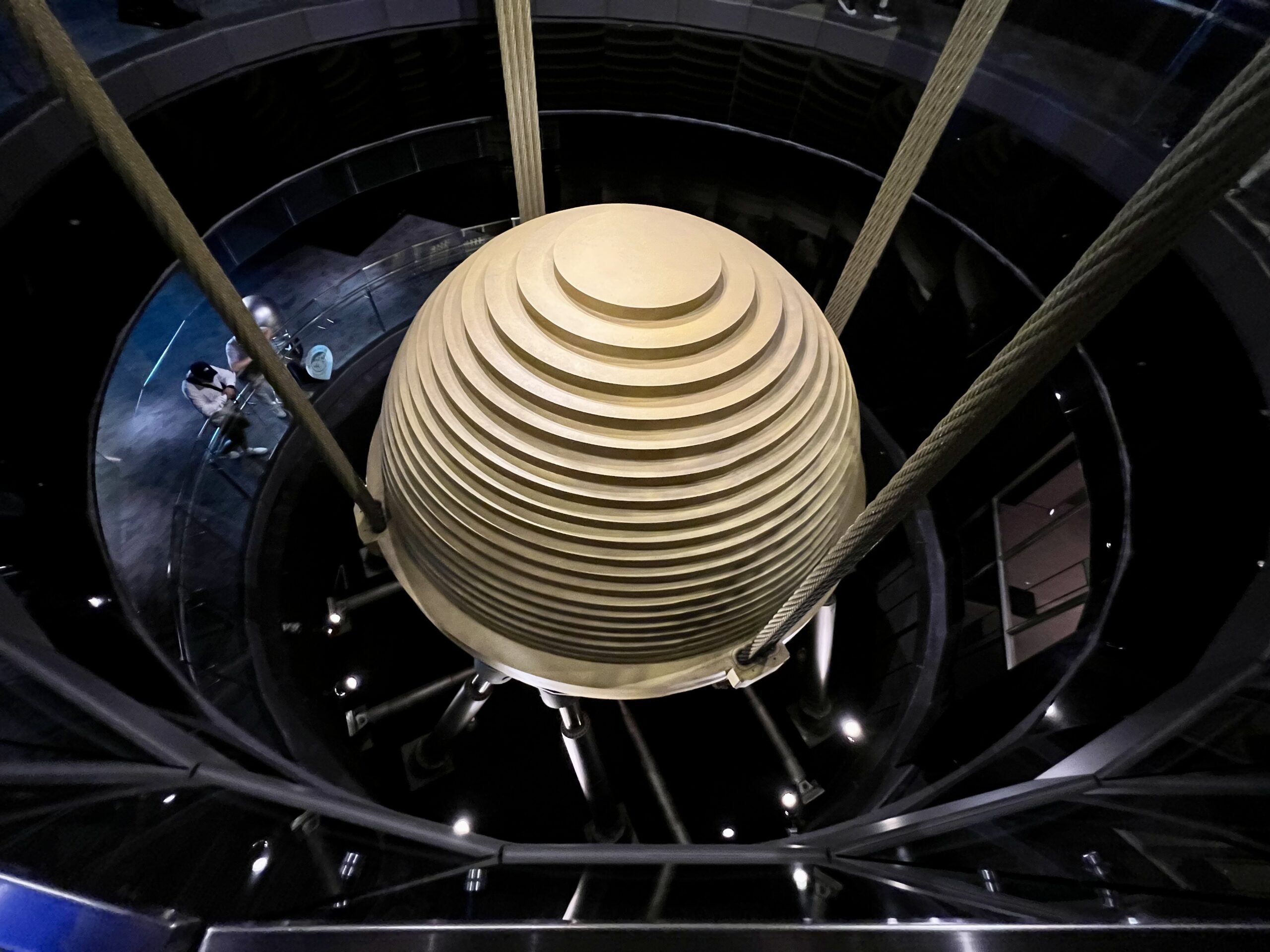
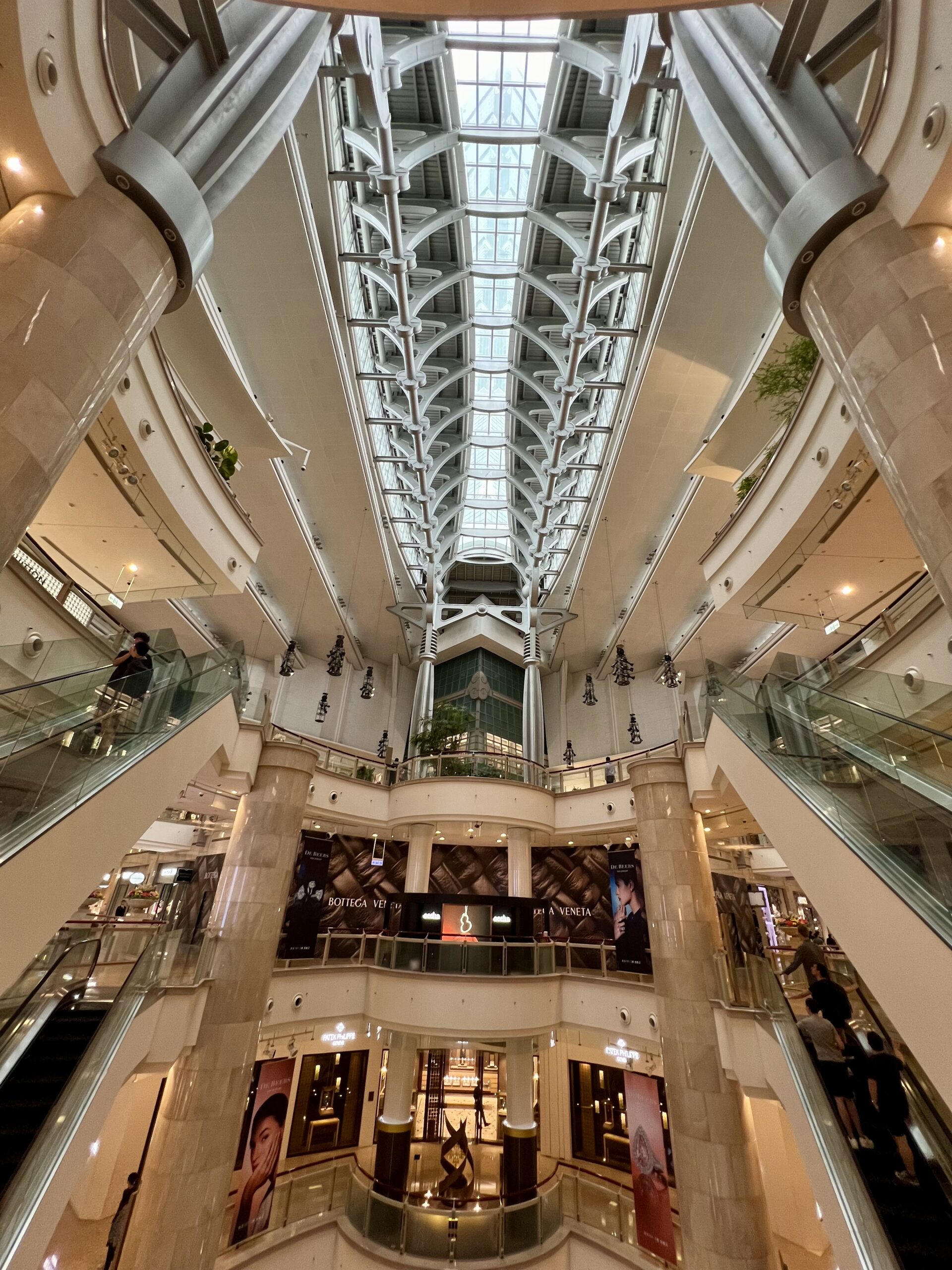
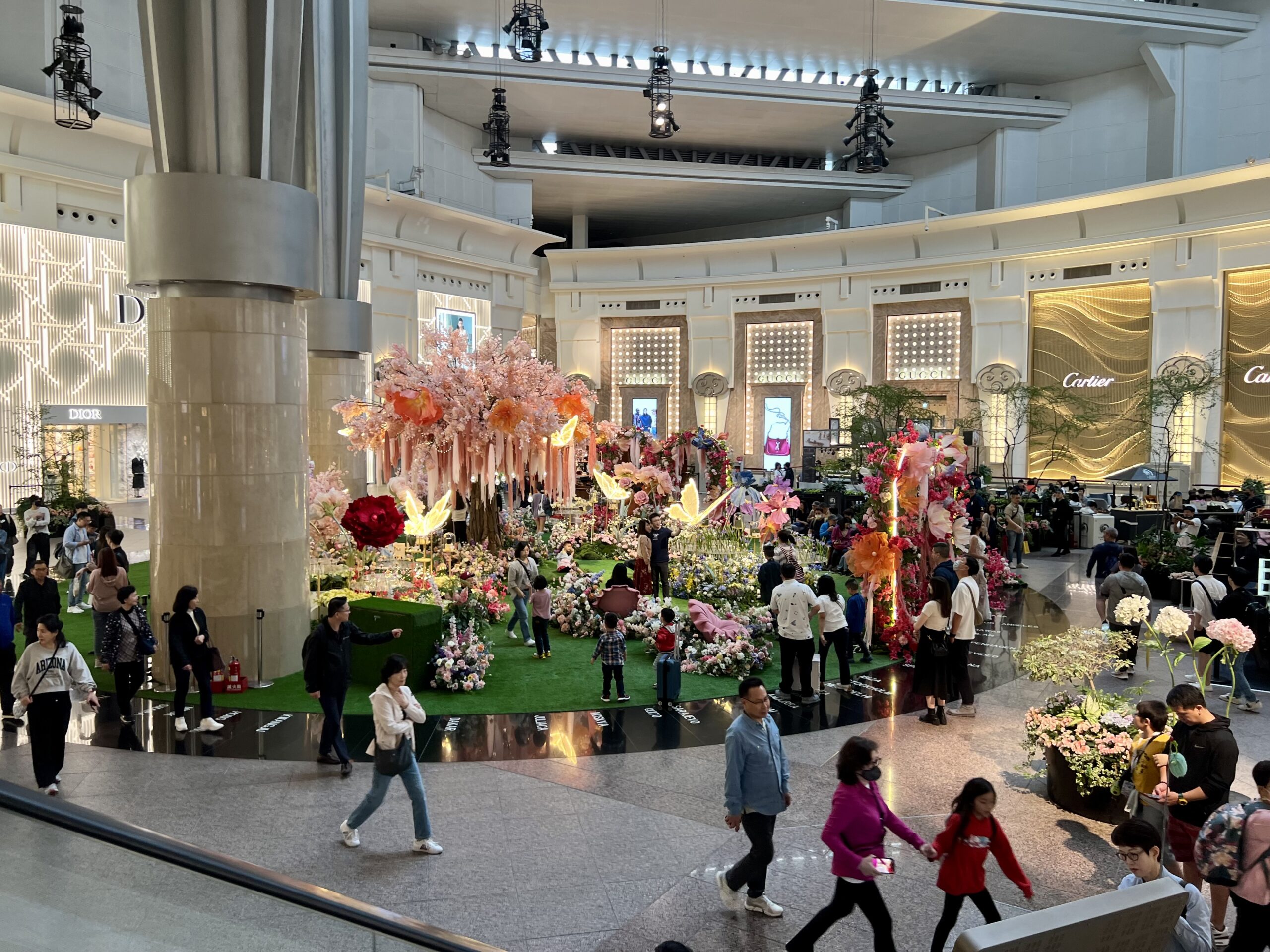
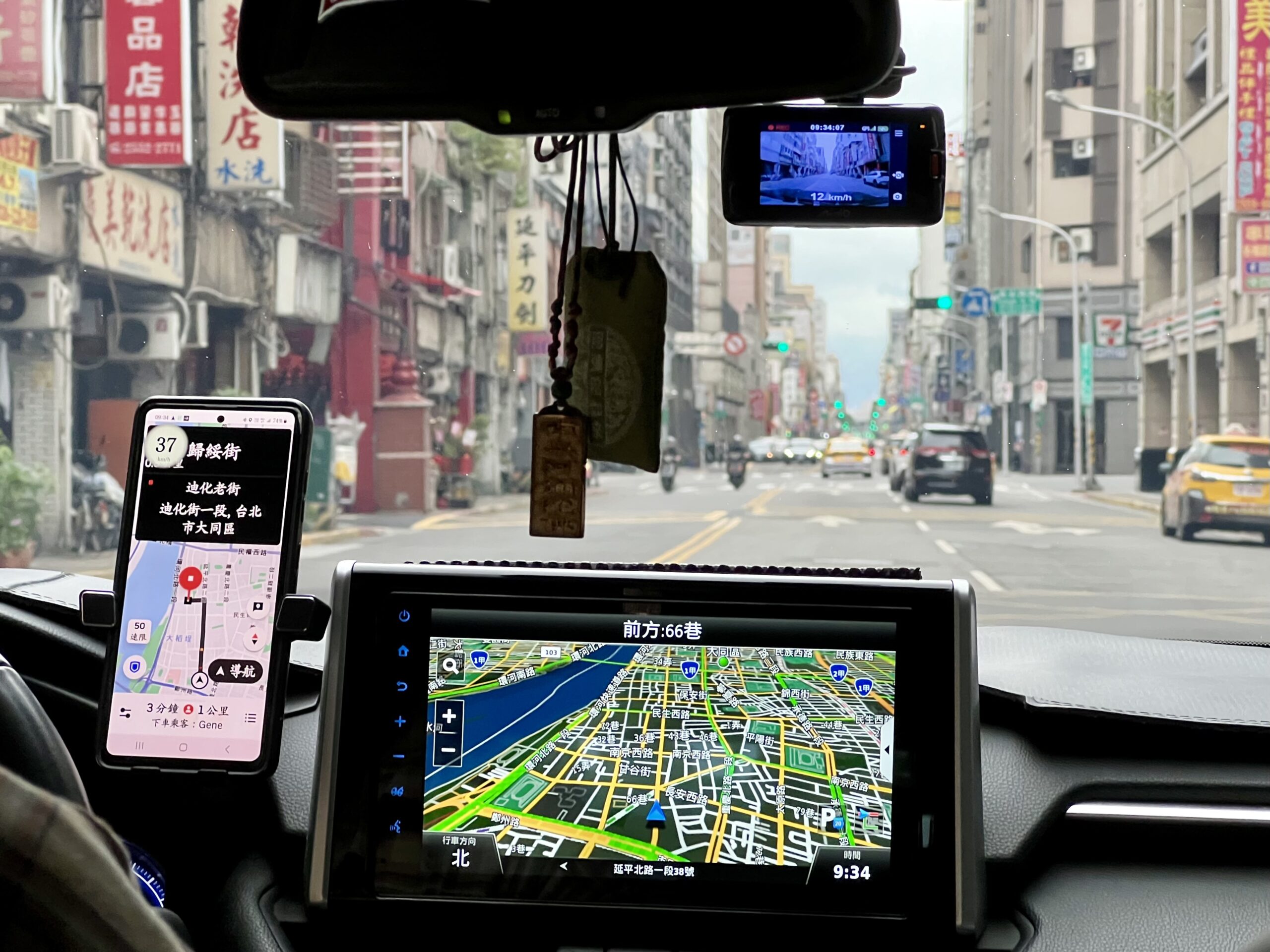
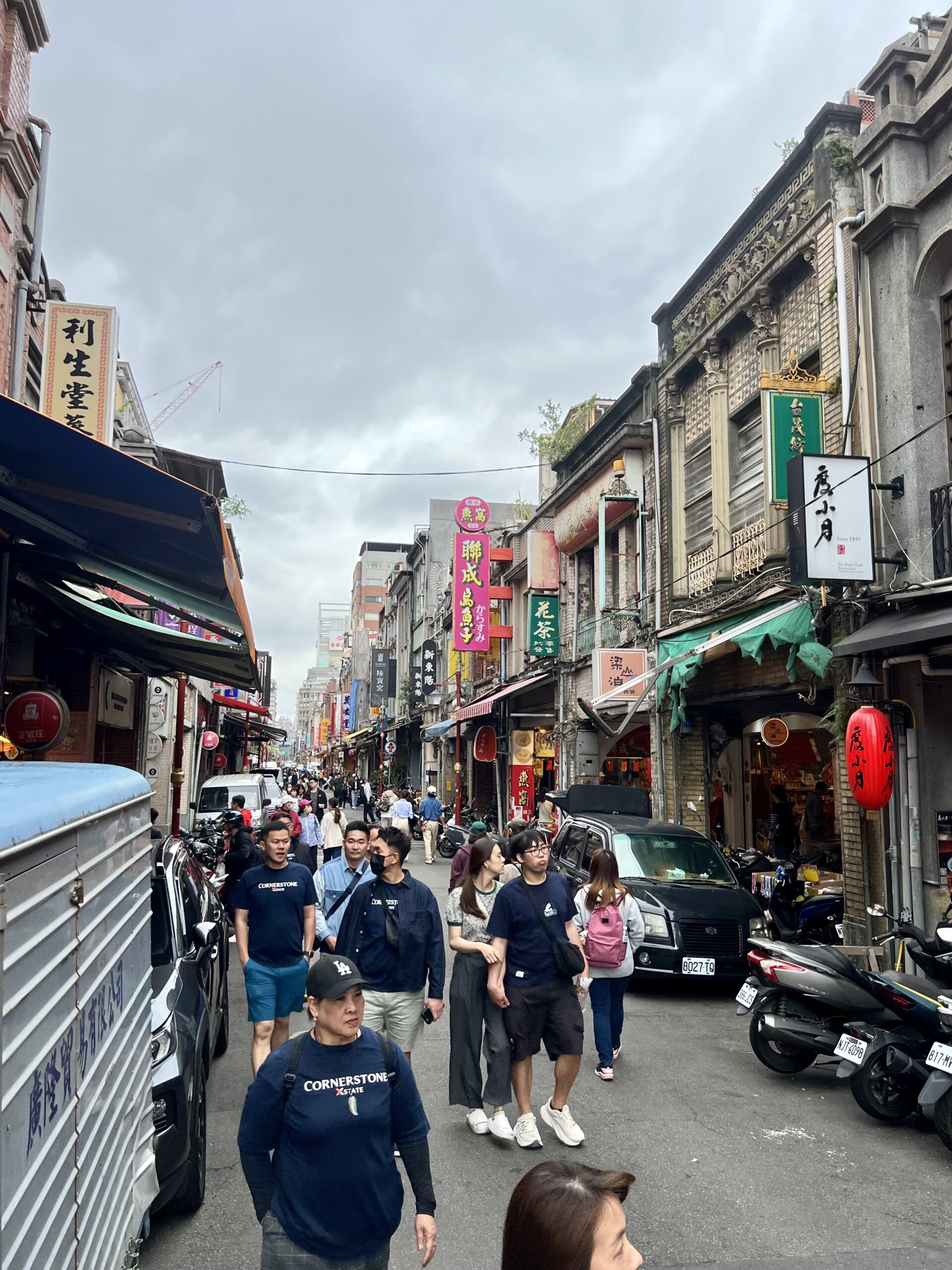
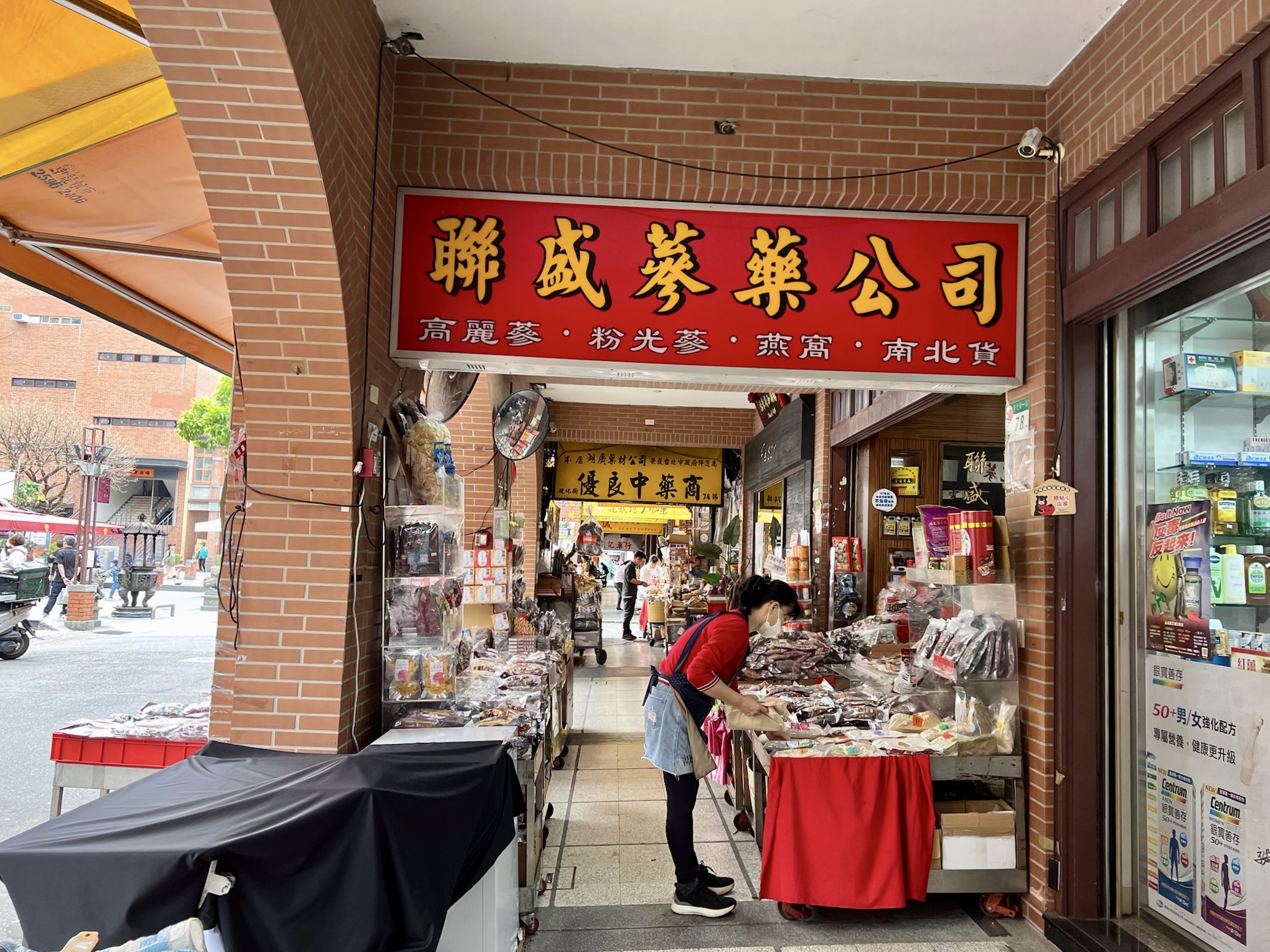
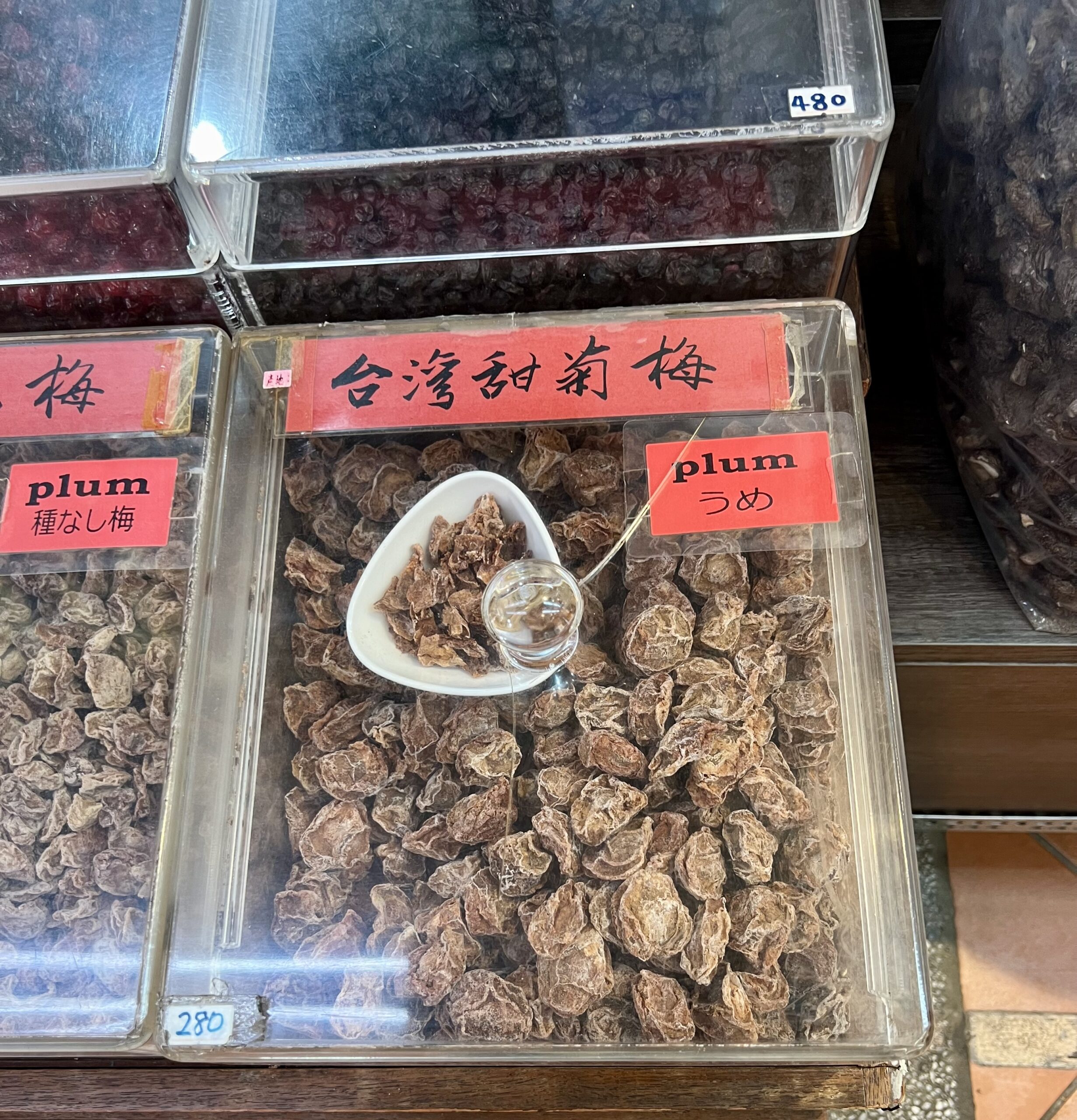
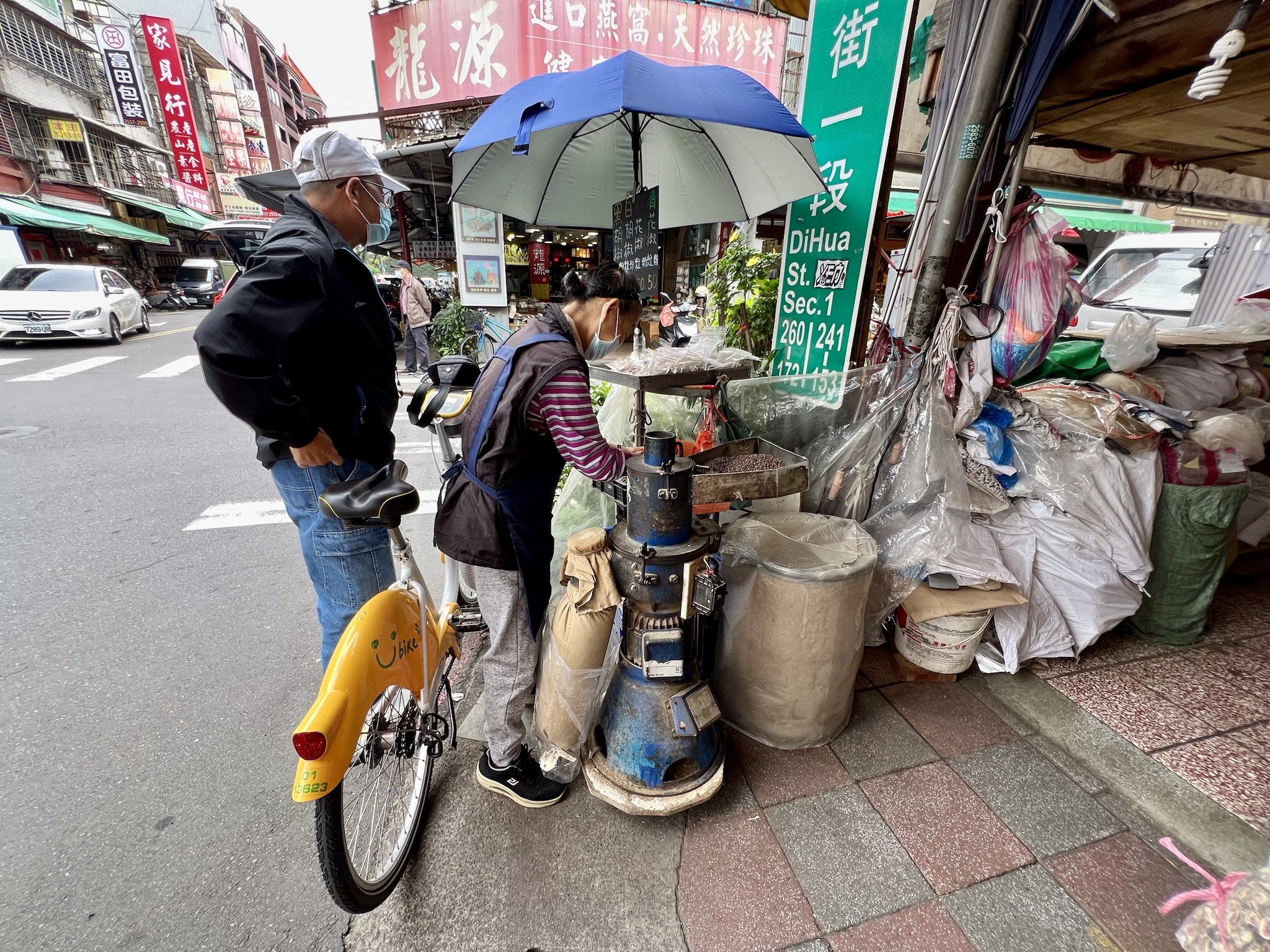
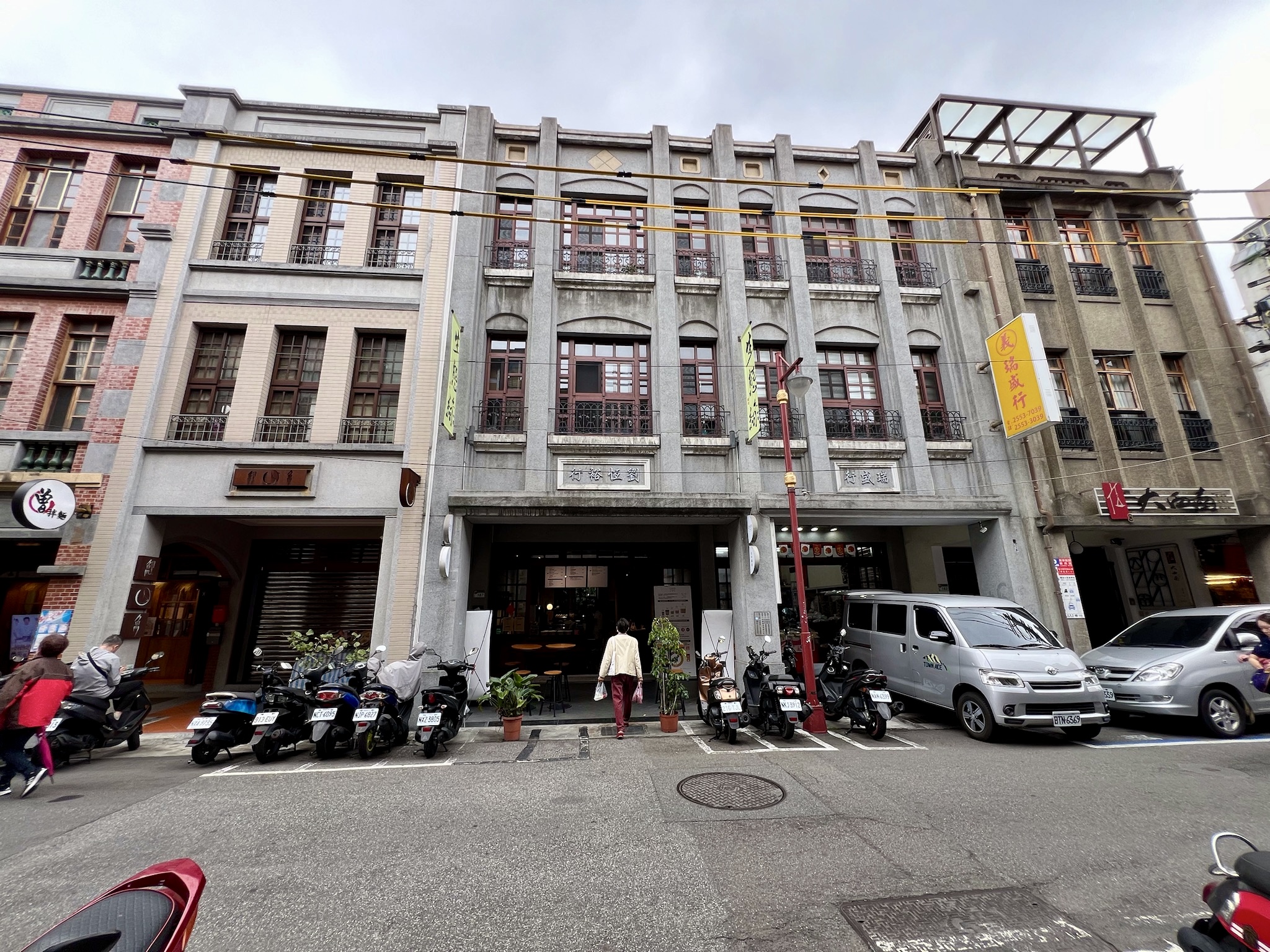
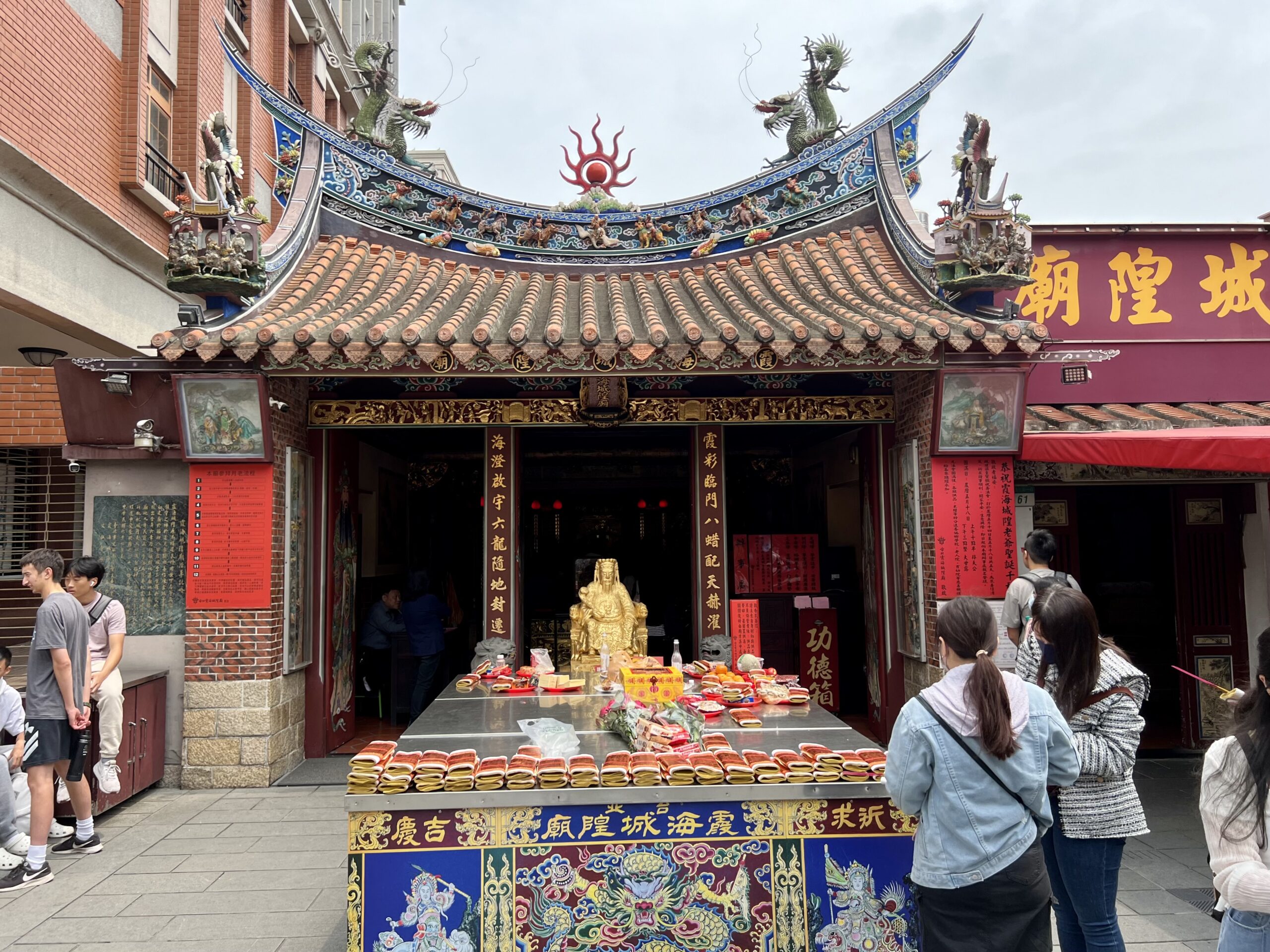
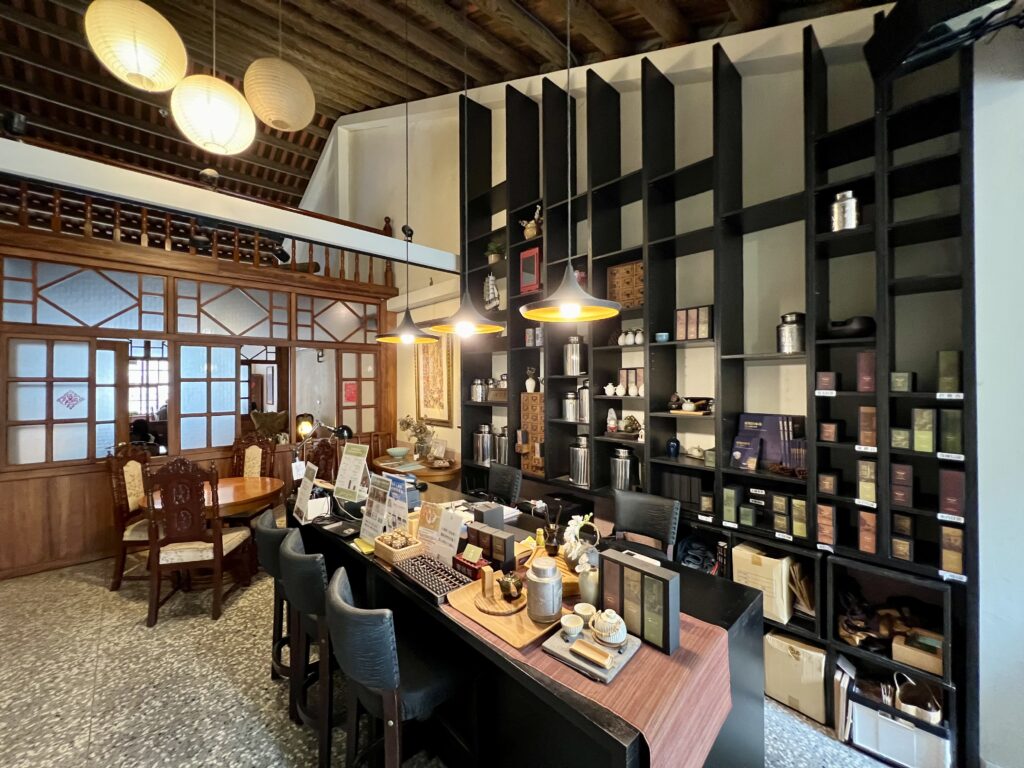
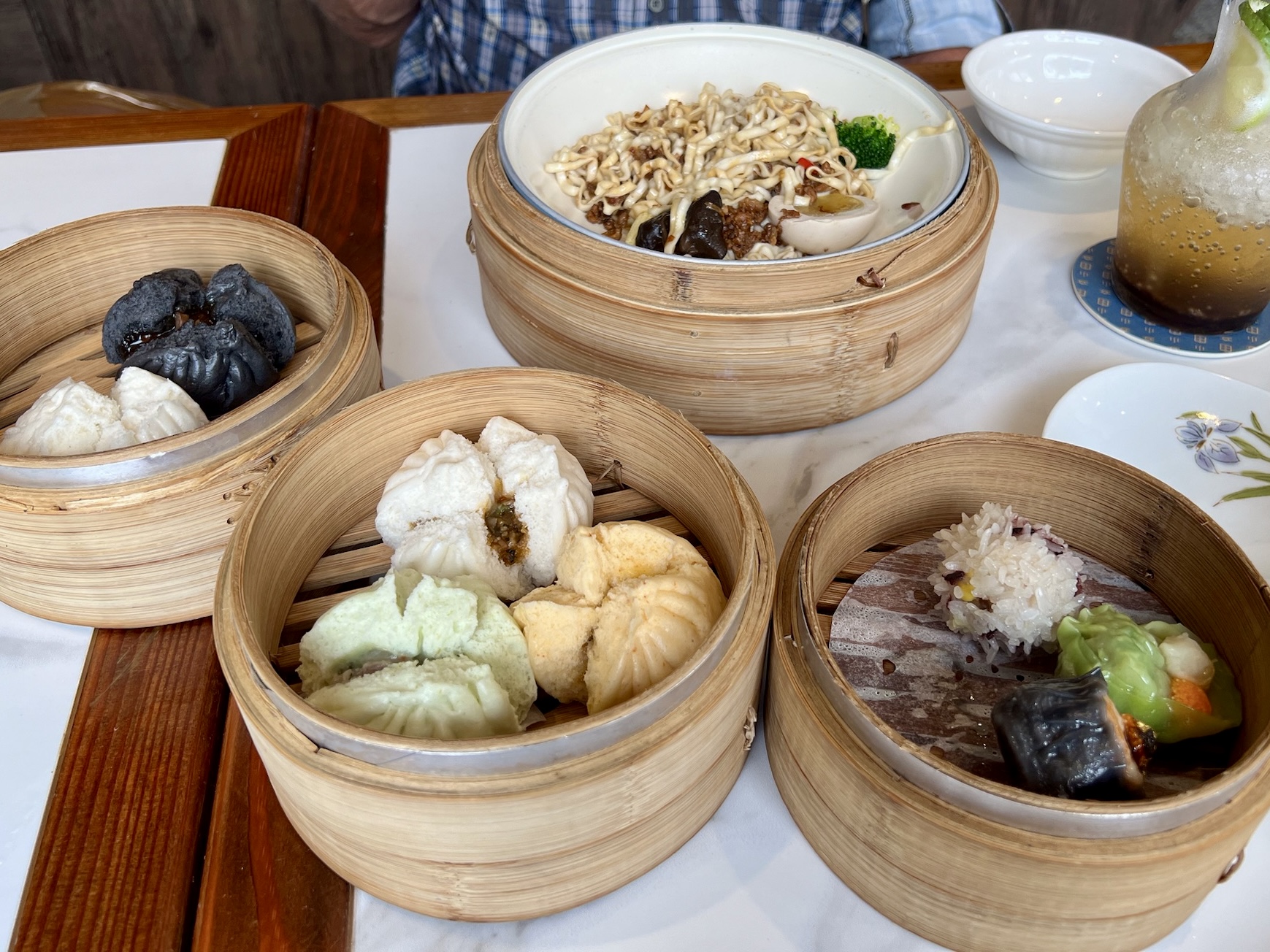
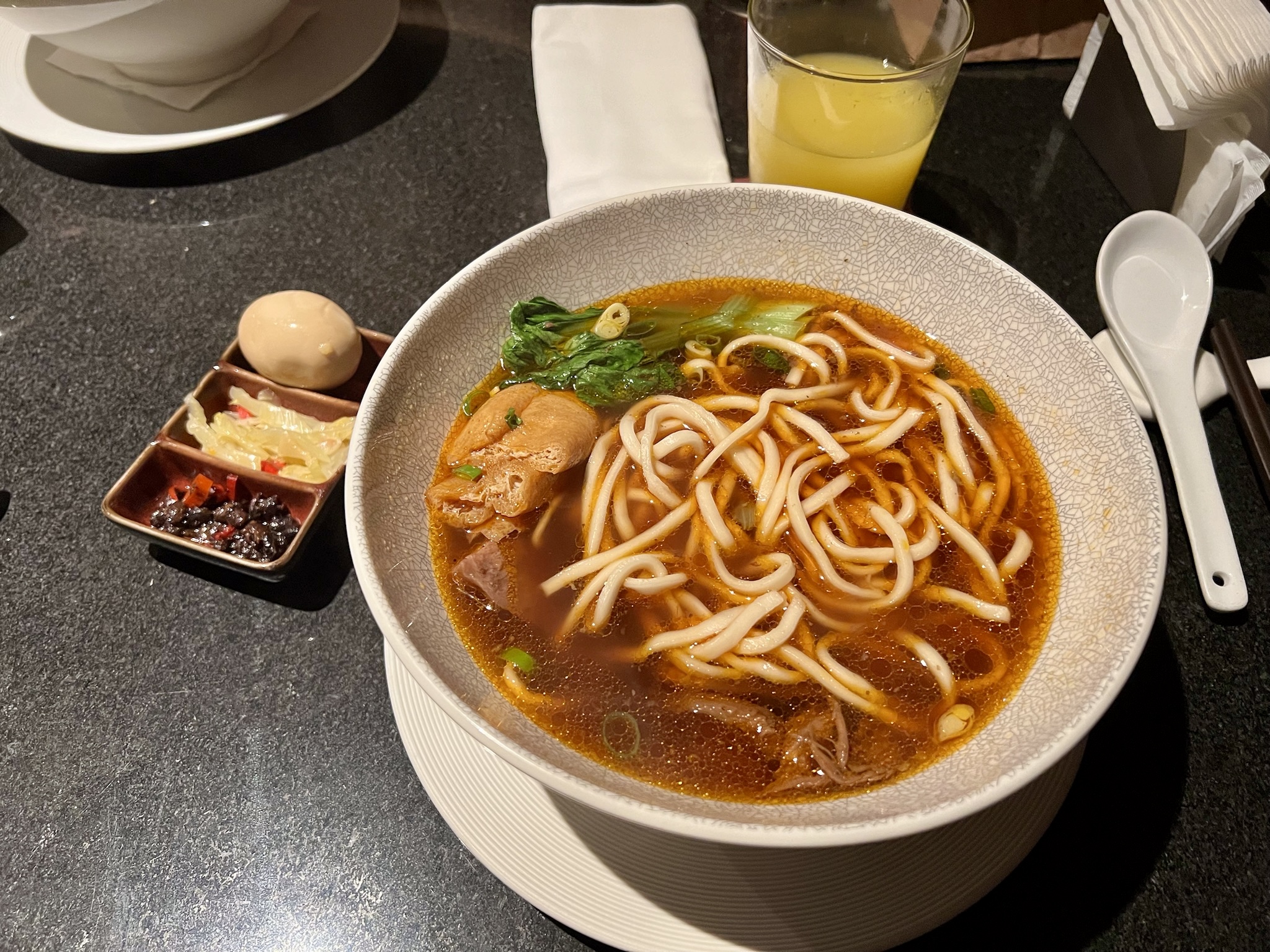
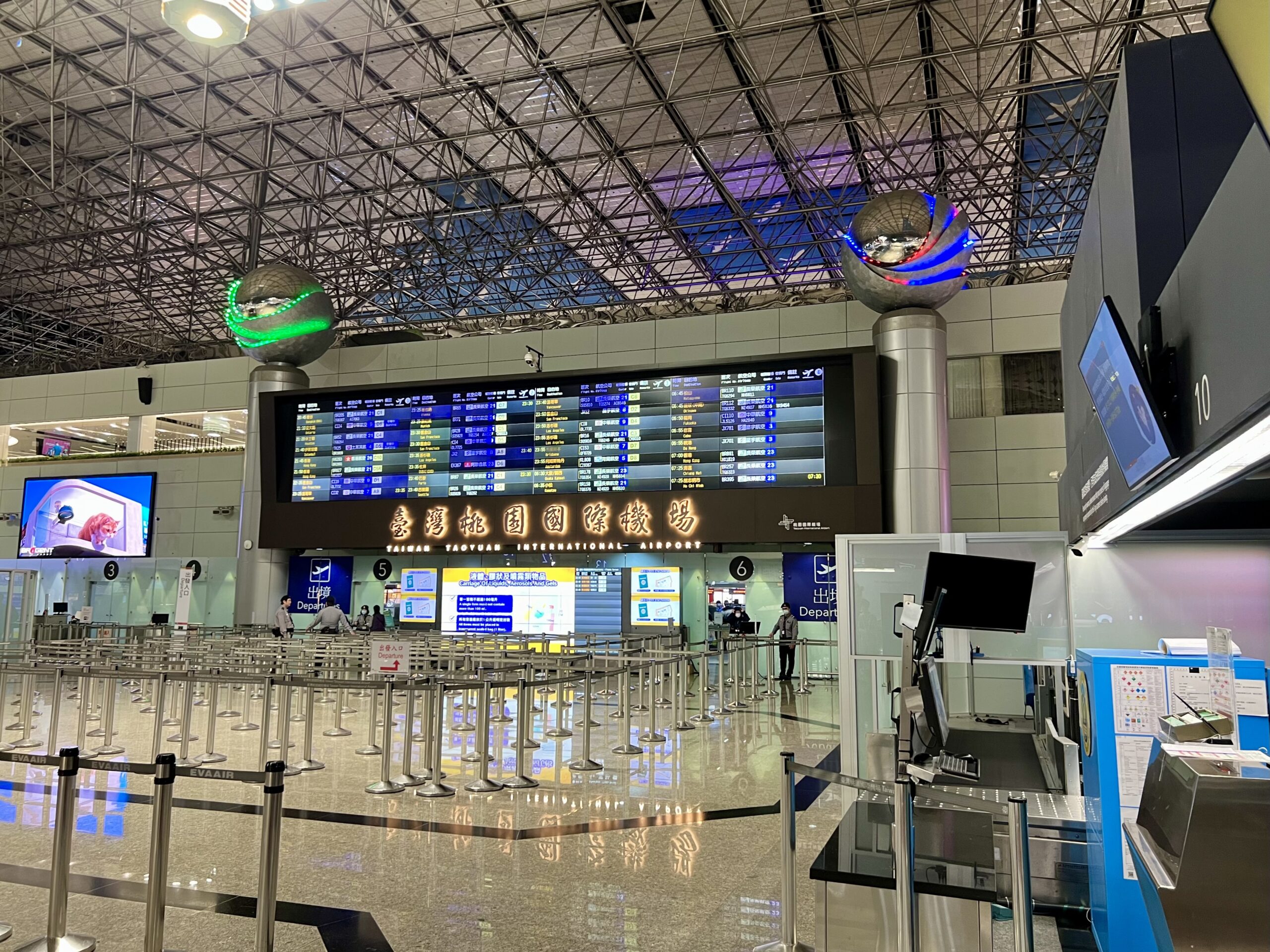
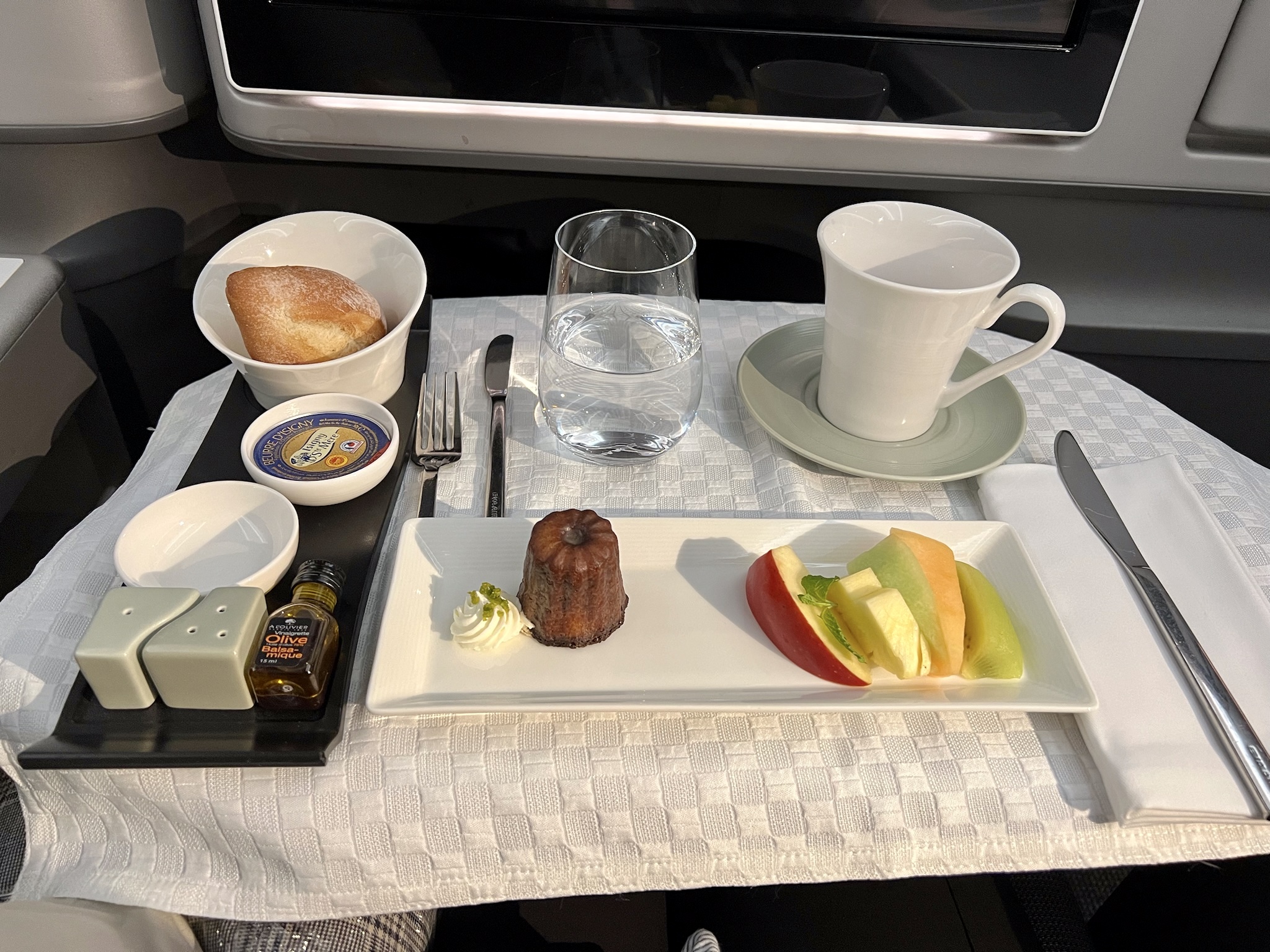
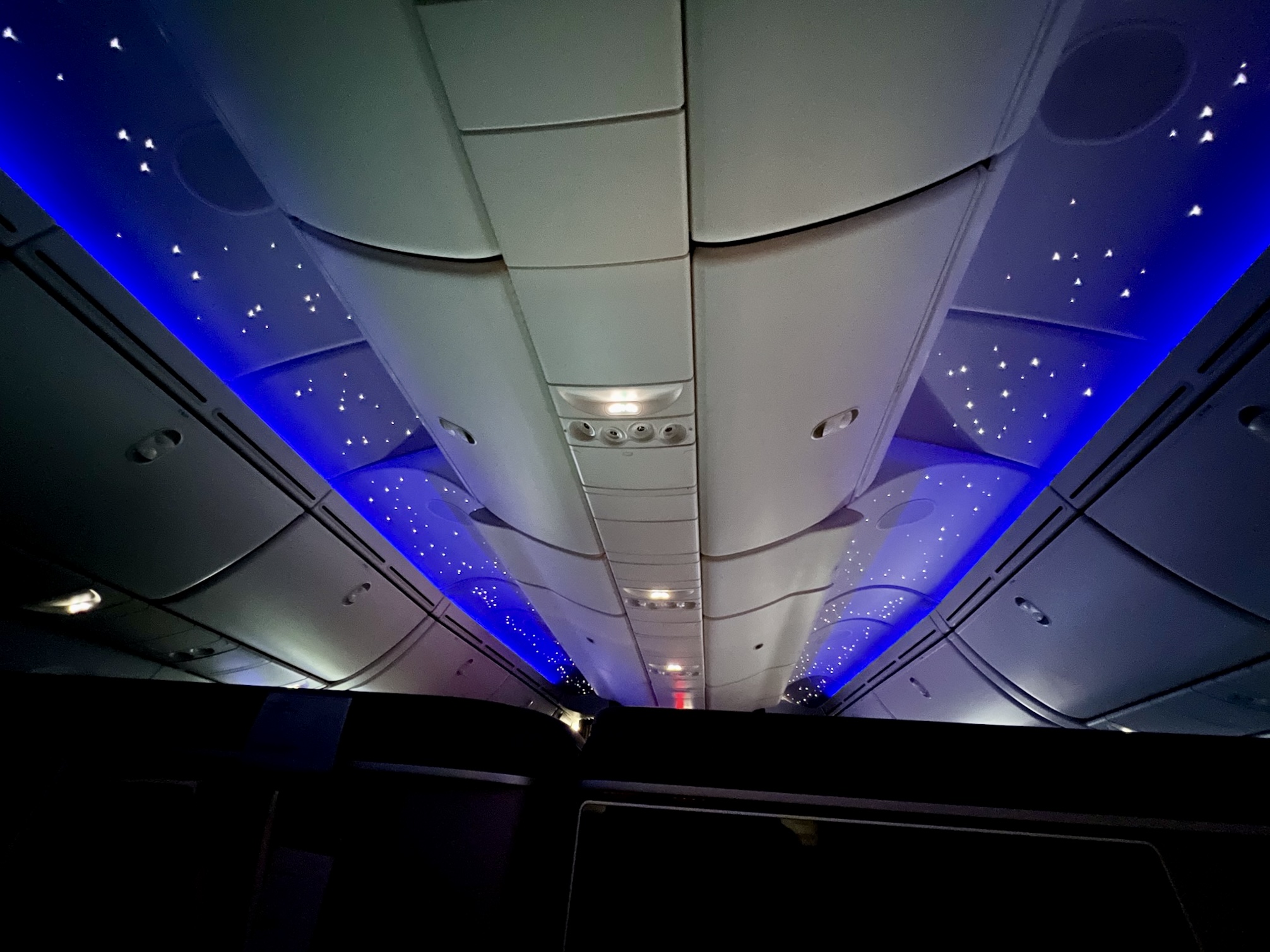
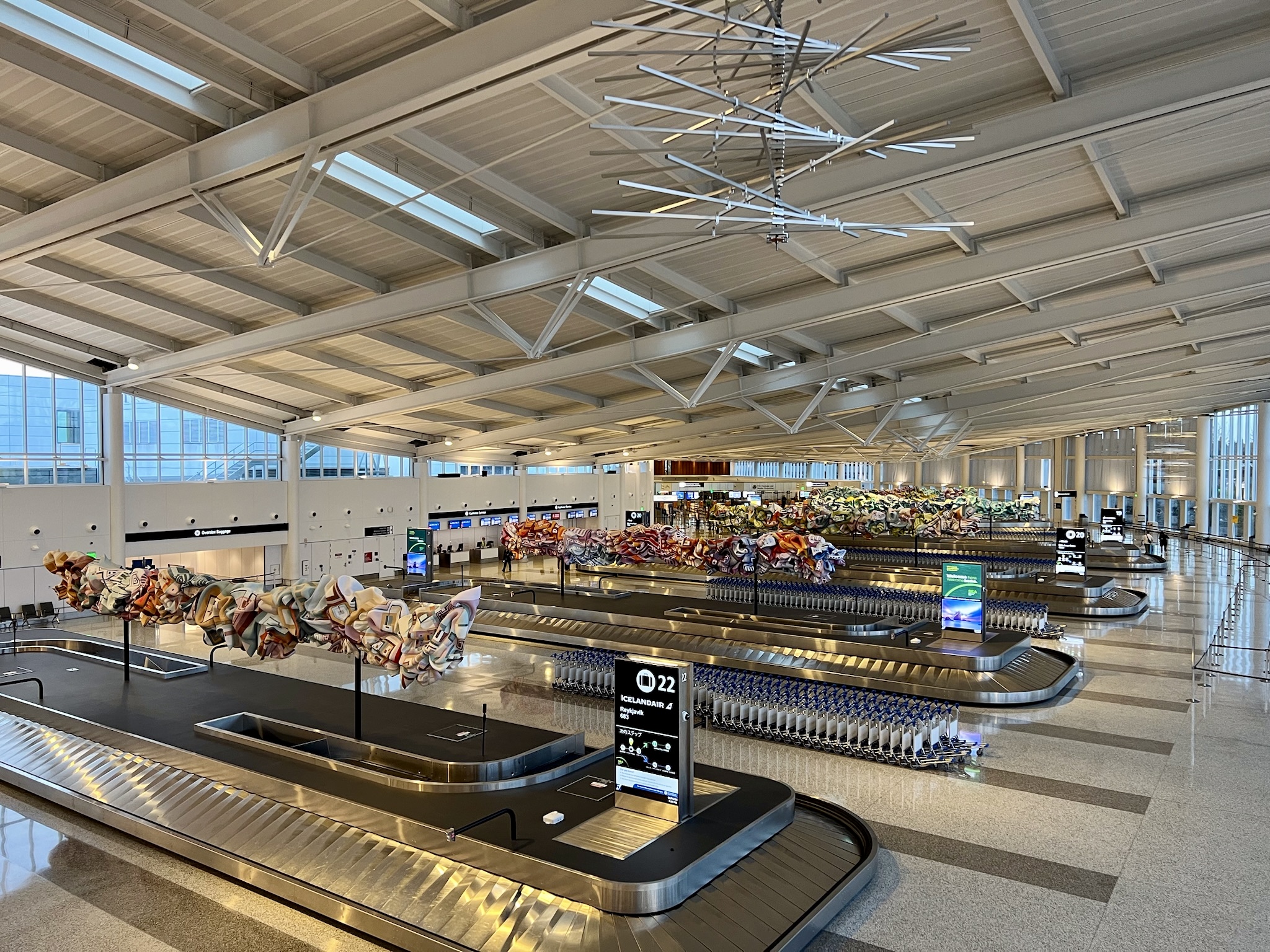
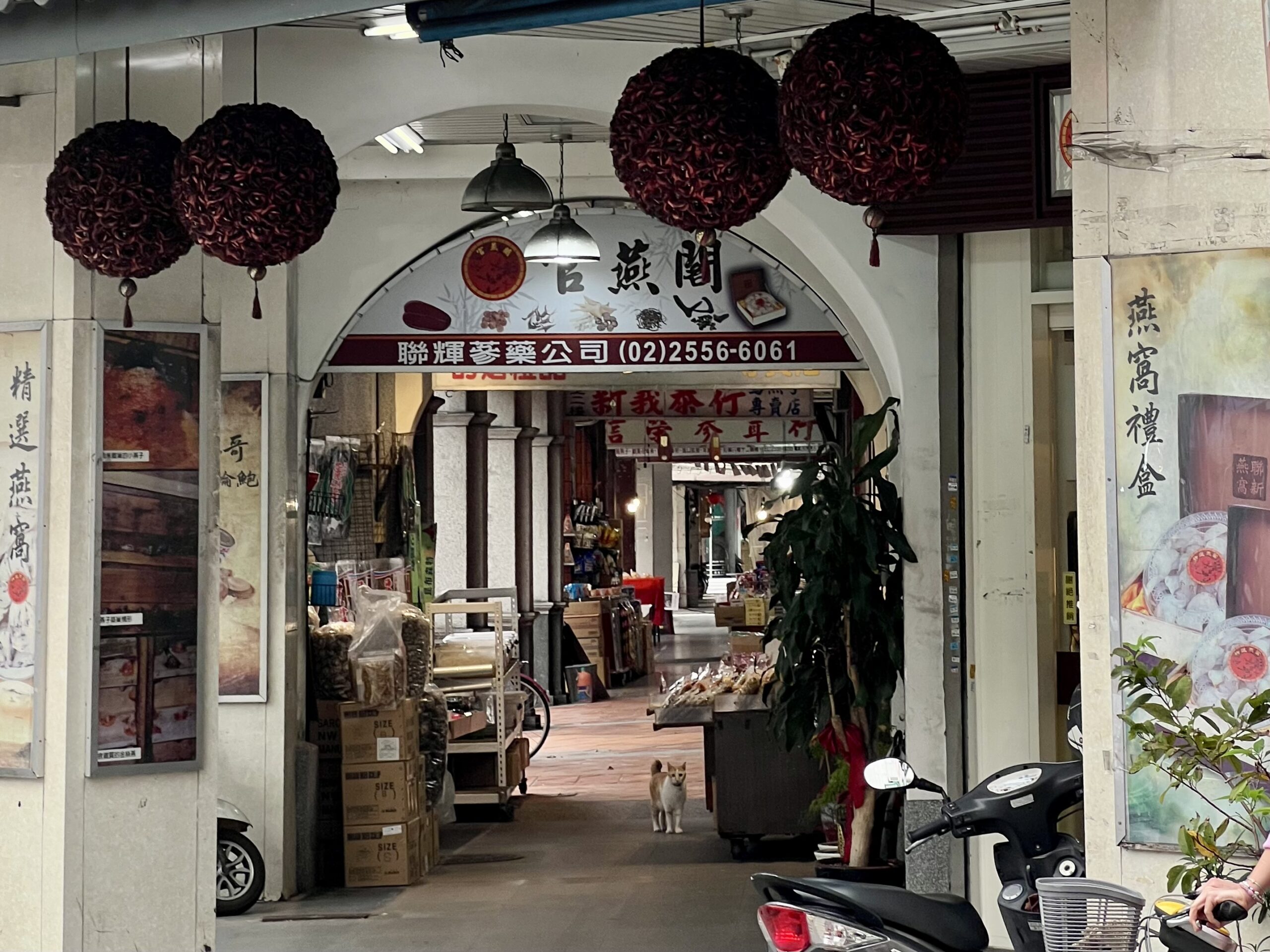
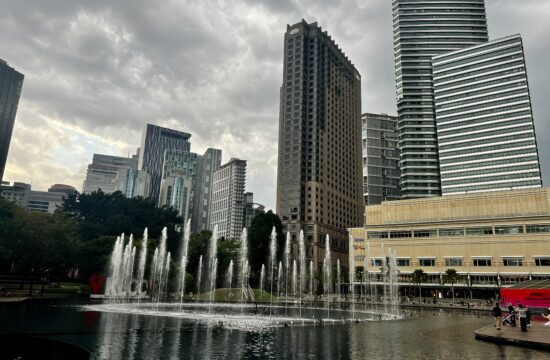
Our last stop in our four months of winter travel was Kuala Lumpur, followed by a short two nights in Taipei on our way home. Here we fly over the Sepang River, in Selangor, Malaysia, as we approach Kuala Lumpur International Airport.We arrived at KLIA1, the international terminal. The flight from Penang was shorter than our drive from the airport into Kuala Lumpur.We once again stayed at the Mandarin Oriental, which is perfectly located on KLCC Park and right next to the large Suria Shopping Center.We checked in early but ended up spending a fair amount of time changing rooms, as they couldn’t get the air conditioning in our original room to do its job right. They ended up upgrading us to a suite. We liked our original room on a higher floor, but the suite was nice, as we could see the park’s fountains from one set of windows (above and below).And the iconic Petronas Towers from windows facing the other way. The Mandarin Oriental in KL is one of our favorite hotels. We opted for a club room, and though we didn’t use the club much beyond a couple of breakfasts, we liked the space and quietness. As for breakfasts, we judged the day’s projected humidity by the condensation on the windows and how well we could see the outside from the inside.Because our visit was during Ramadan, in addition to decorations, the hotel featured a live gamelan degung ensemble each evening. The music and instruments are endemic to the Sundanese and use a different scale. Though the rhythms have an Asian sense to them, the different scale is probably why its tonal quality sounds so uniquely different from other music.Even though we flew west, the Malaysia time zone has it so the sun rises an hour and a half later than in Vietnam. This worked out well for us, as we got more time in the cool of the morning. “Cool” being an entirely relative concept, of course. On the mornings when we didn’t have plans that got us on the streets early, we went down to the pool after breakfast and relaxed until we’d digested enough to hit the gym. We’d not stay past lunch, though, as it got too hot to enjoy even a good book.In the late afternoons and early evenings, brief thunderstorms were common. The first hour or so after a downpour, the humidity is off the charts. But then they actually cool things down quite a bit, which led to pleasant post-downpour evening walks through the park.The Suria Shopping Center next door also opens onto the park. It conveniently filled both our need for necessities and our desire to people watch. As it was Ramadan, the people watching part was over the top. The minute the sun set, hungry hoards descended on restaurants and malls.The number and diversity of restaurants at the Suria center is amazing. There are more restaurants than retail stores. On Easter Sunday, we ate at Serai, which is Malay for lemongrass. We had a braised lamb shank with lemon grass harissa and roast chicken in Malay spices with mango sambal. And sweet iced lemongrass tea to drink. Yummo.Kuala Lumpur has a very good light rail system. The only trouble we ran into was sorting out the acronyms for the different connected systems – MRT, LRT, ERL, KTM. We took the LRT to the MRT to get to the Perdana Botanical Garden and the National Museum of Malaysia.On the MRT, we mistakenly entered a pink door and rode in a pink car. A mistake for one of us, anyway, as pink cars are for women only. Oops. Our first destination, the botanical gardens, is as much a large urban park as it is a garden.It has architecturally covered plazas (above), with architecturally interesting trees poking up through them (below).This tree was labeled as a bottle tree. Clearly it’s a corkscrew tree.Through the lower parts of the park, paths lead along waterways and wind between small lakes and picnic areas.Other paths lead up slopes, through gardens and past waterfalls (above and below).The temperature was in the 90s, and the humidity made it feel like someone had left the shower running. So we were somewhat taken aback by the runners and joggers we ran into. Cheese had obviously slipped off of some crackers.Not too far from the gardens, maybe about a mile if you were a crow willing to risk heat exhaustion to fly there, is the National Museum. It was a bit farther for us due to our zigzagging through puddles of shade.The museum is small but smartly laid out and takes visitors through four galleries of progressive history: Pre-history, Malay Kingdoms, Colonial Era, and Malaysia Today. All decked out for Ramadan, of course.The artifacts are beautifully and intuitively arranged, with clear descriptions in both Malay and English. Displays starts with the stratigraphic layers of stone dating back 250M years to the Permian period and work forward through the diverse cultural influences of the past 2,000 years. Like this Hindu-Buddhist statue from the first millennium CE.And this Arabic grave marker of a 15th century Malaysian sultan.And this Chinese influenced dragon from the prow of a ship.The final gallery began with the technology used to tally the first official vote of the new Federation of Malay States. It is a little disconcerting, though, when the dates on the old stuff in a case are younger than you are.Speaking of being younger once, our first visit to Kuala Lumpur was 30 years ago. We remember taking pictures – with Kodak film – of the different-looking high rise buildings at the time. They are dwarfed now by the new generation of 100+ floor skyscrapers. The Petronas Towers shown here was the first of the super-tall buildings and was still under construction on our first visit.New tall towers sprouted up in quick succession, but they maintain the architectural variety of the shorty high rises we admired 30 years past.The vertical real estate in most US cities is strongly rectangular, with maybe one building standing out, like the Transamerica pyramid in San Francisco. In contrast, it seems every Kuala Lumpur building has any number of angles and things sticking out.Thanks not to say that they can’t do rectangular in a big way, too.And Arabic design elements are common, like this new building rising above the 130+ year old Central Market near Chinatown.One of our Metro excursions took us into the old Central Market. This lone rickshaw is the only thing left of its early character, though, as virtually every shop here sells only colorful tourist stuff now.The photographer was attracted to this shop in particular, probably because it pushed all her right-brain color buttons. To be fair, other stores with their dragon kites and silicon Hello Kitty purses were just as colorful.On the outskirts of Chinatown is the Sri Mahamariamman Temple. The oldest Hindu temple in Malaysia – and reputedly the richest. It is decorated in the wildly colorful style of southern India temples (above and below).Founded in the 1880s as a private family shrine, it was opened to the public in the early 20th century and became an important temple for Indian immigrants.The main sanctuary is centered on the god Parvati, an incarnation embodying Mother Earth. On either side of her are her sons, the elephant god Ganesh on the left and his brother Marugan, the god of war, on the right.The gentleman here is paying respect at the alter of the god Marugan, an important god for the Tamil people of India and Sri Lanka. We spoke at length with him. He is from Chennai, India, which is the Capitol of Tamil Nadu. He happily educated us on this little corner of the Hindu pantheon.Since we were in Chinatown, we figured we’d visit Chinatown. Just down the street from the Hindu temple is the Taoist temple of Guan Di, an accomplished Chinese general and now a god of war. Established about the same time as the Sri Mahamariamman Temple, it serves an equally important role in anchoring the Chinese immigrant community.If there is a heart to Kuala Lumpur’s Chinatown, it’s Jalan Petaling or Petaling Street, so named because it was one of the main streets of early KL and led to the tin mines in Petaling. This is the go-to market for buying counterfeit everything. If you want a “top quality Rolex” you need look no further.We ate lunch at the only air conditioned restaurant we could find, albeit we had to wade through knock-off sellers to get to it. The photographer ordered the classic Chinese dish chicken Hor Fun, on the right, while the blogger played it safe and ordered Malaysian beef Daging Dendeng with mango pickles. The beverages are sweet calamansi juice with sour plums and mint.We had to have the Cendol Ice for dessert. Cendol is pandan-green, worm-like jellies, and it’s served over shave ice with sweet red beans. The ice is drizzled with coconut milk and palm sugar syrup. It’s very refreshing, unless of course you are worm-adverse.Most of our excursions kept us within what is called the Golden Triangle. It’s kind of like Kuala Lumpur’s CBD, though its chaotic, winding streets seem anything but conducive to doing business.And not all shopping experiences in the area are created equal. This mall felt more like a series of service hallways, but it’s where we found Mr. White to do our wash-and-fold laundry by the kilo. One of our favorite trips is to the Dharma Realm Guan Yin Monastery, a Buddhist monastery, behind which is a big vegetarian food hall.Run by the monastery, it’s like a canteen, with pan after pan of creative vegetarian dishes. Each one different. The cashiers stare at your plate, count up the variety you’ve taken, and somehow come up with a price. We took one of everything, of course, plus a flaky fruit-jam cookie, plus a black-bean mochi ball, plus a sugarcane juice. So we figured our cost was at the high end of the range. About USD $6, all told. Most customers take just a few items, so a meal here must be incredibly affordable. A fellow joined us at our table who works in IT at a nearby company. Almost every person eating looked to be a local office worker, plus a few western expats in business attire.The photographer found us another interesting restaurant, Bacha Coffee. It’s actually a Moroccan coffee room specializing in globally sourced arabica coffee, which also serves Moroccan food. It’s a chain of sorts, if you count two restaurants a chain: the original in Marrakech and this one in KL. Apparently the coffee room is inspired by the Pasha’s residence in Marrakech. Having visited the residence, we recognized the pictures they had about. Apparently they contributed to its restoration. Small world.Their food is excellent. We had a Mediterranean chicken stew – really a tagine dish without the tagine – and a spiced chicken semolina flatbread. Yummo2.On our last evening in Kuala Lumpur – and Malaysia – we ate at the Little Penang Kafe. Penang cooking is popular here, so we had to employ our Ramadan Dining Strategy, which means we need to get a seat before 6:00pm. You see, Iftar is at 7:23pm, when Muslims can break their fast. Starting at about 6:30pm, restaurants begin to fill up with people sitting at empty tables, counting down the minutes and seconds until they can eat. Popular restaurants, like Little Penang and Chili’s (yes Chili’s) get so busy they start queuing people up early. 6:00 gets us in and a table. We ate Nasi Lemak (chicken curry) and Kari Hantu (beef curry).For dessert, we had their rustic version of Ice Kacang.Then back to KLIA1 and a four and a half hour flight to Taipei. The 7.4 magnitude earthquake Taiwan had didn’t impact Taipei much. We stayed at the Grand Hyatt Taipei. The international Grand Hyatts are a lot nicer than the domestic ones, but they’re not on par with Mandarin Oriental and the like. The hotel is in the new part of old Taipei, if that makes sense. We chose the Hyatt because it’s right next door to the Taipei 101 sky scraper (below).It’s called Taipei 101 because it’s 101 stories tall. The top of the tower was in a bit of cloud, which made it look a bit blurry.As a result of the clouds, the only view we got from the top was straight down.One of the things that made the trip to the top worthwhile, despite the clouds, is the building’s tuned mass damper – over 700 tons and the heaviest in the world. You can see it from internal observation decks. It’s a passive device tuned to the building’s natural frequency. It provides structural stability and makes being on the top floors more comfortable by creating a counter force when earthquakes and winds wiggle the building.Beneath the tower is an upscale mall. We ate pineapple cake and bought some to take back. Pineapple cake is a popular Taiwanese pastry – soft shortbread outside and jammy pineapple inside. In Taiwanese, the word for pineapple also means “prosperity arrives.” Who doesn’t want to eat cake and prosper?On the top level of the shopping center is a vanity garden. It’s a fantasy of fake plants designed for selfies, and gets a lot of use. The weather was perfect for walking around: 70s and cloudy. We took an Uber-taxi to Dihua Old Street, which is just off the river in the middle of old Taipei.In any other city, Dihua Street would be called Chinatown, but that would make no sense here.There are a few souvenir shops, but most of the shops on the street sell tea or traditional food items, like dried mushrooms and sweet-salty plums (below).We bought a big bag of these Taiwanese Li Hing plums, which they call Stevia Plums. We loved the scents. Incense mixed with sweet-salty-peppery-anise aromas. Here a woman is grinding fresh black pepper for a customer. What an amazing smell. We were a little puzzled by the orderly street parking. Stalls for motorbikes? In Vietnam, you’d probably get arrested for parking in such an orderly way. There’s only one temple on Dihua Street, the Taipei Xia Hai City God Temple. Built in the mid 1800s when this area was a port town, it’s a kind of Swiss army knife of a temple, with the City God seeing to prosperity, safety, and a ton of other stuff, his wife, a Chinese cupid tending to love life, and about 600 other gods for good measure. Handy.We stopped for tea at an upstairs Taiwanese tea house. After selecting our teas with the help of sniff jars (below), we were served tea and nibbles. Tea houses are a bit of a mystery. You’re supposed to sit and relax to soothing music while consuming caffeine. We drank, nibbled, and went back to walking around. Dihua Street runs parallel to the old port area on the Tamsui River. A flood wall stands between streets and the river. The Tamsui River is old Taipei’s reason for being. It provided fresh water and access to the sea. New Taipei is a large urban ring around old Taipei. This view looks across the river, with buildings of New Taipei on the far shore.For lunch, we ate at a third-floor walkup dim sum restaurant. We had the best dim sum of our trip, but only after agreeing to spend at least 300 TWD each (~USD $10) and to not stay longer than 90 minutes. You-eat-you-pay-you-go codified. We had dinner with our nephew, who just happened to be in town on business. All three of us ate the same thing: Taiwanese Beef Noodle Soup. Comfort food. Then it was time to leave for home. The airport was quiet for our midnight flight. Once on board, the photographer had a light snack before lights out. The blogger went straight to horizontal with his blanket and earplugs. Then we were home in Seattle, collecting our luggage and through passport control with Global Entry. It was a fun trip.